The Role of Play in Early Childhood Education: Why Children Learn Through Play-based Methods
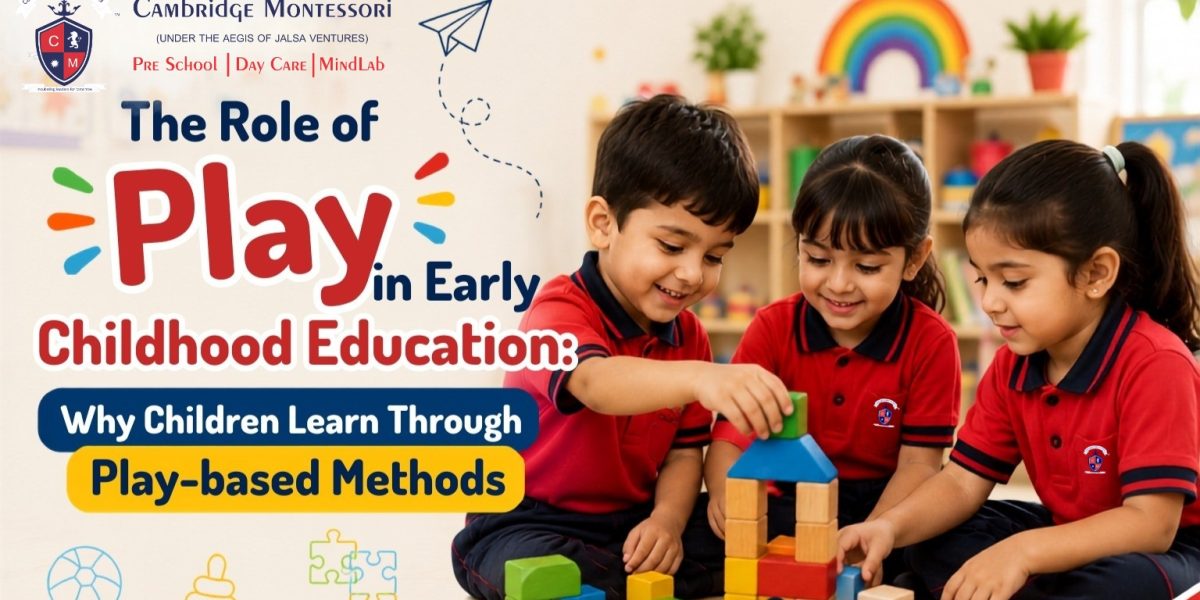
While watching child making a “building” out of blocks, it is easy to mistake their activities as just play. Looking closer, one realises that it is a remarkable activity in practising language, negotiation, early mathematical ability and problem-solving ability, entirely led by the children without any adult supervision.
This insight drives early childhood education because for young children, play is an important part of learning itself and an important way for them to make sense of the world around them. Here we explain how different kinds of play builds different abilities. We also provide full articles on topics that demand more explanations.
Why “Playing” Is Serious Learning
Playing is fun way to learn for young children, and often there are few differences between learning and playing for them. While a child plays, they are also rehearsing skills that are essential for life. Research also supports this observation, as an important report from the American Academy of Paediatrics also explains that play for young children builds brain structure and enhances cognitive ability, and also activates the reward centre of the brain which manages motivation and reduces distractions (Yogman et al., 2018). Play directly helps with building cognition for a young child.
Many learning systems emphasise on this aspect about play, and play is incorporated into many methodologies including the Montessori method of teaching which depends upon purposeful, child-led activities for a child’s development. We cover this in How Play-Based Learning Supports Early Childhood Development.
What Research Says About Play
Research has made several findings about the impact of play-based activities on a child’s mental development.
Play helps in teaching academics even better than teaching instruction. Parents find this surprising. A finding derived by the U.S. Department of Education’s research wing highlighted that for young children, guided play was more beneficial for teaching academic content instead of direct teaching (IES / Institute of Education Sciences). Children learn best in a playful and interactive environment, with direct play aiding their cognitive development.
Play builds learning skills. Play builds creative thinking, collaboration and executive function – functions that have lifelong uses. The LEGO Foundation’s review “Learning through Play” gathered evidence that these skills develop best through joyful and socially interactive play (Zosh et al., 2017).
Play provides holistic support. According to research, play-based learning benefits a child in a holistic way. These benefits are explored in the article Why Play Is Important for Child Development.
Free Play vs Guided Play: An Important Difference
A difference worth noting is that play-based learning does not mean that children are left to themselves to play all day. There is a difference between free play, which is led entirely by the child, and guided play, which is supported by an adult towards a learning goal. Both kinds of play are important. Free play leads the child towards independence, creativity and social skills, while guided play is when a teacher sets up an environment and intervenes through well-timed questions, which is extremely important (NAEYC).
The balance between knowing when to intervene and when to let child-led play unfold is the key role of the Montessori approach, and separates play-based education from supervision.
How Play Can Support Learning
Supporting young children’s play does not require toys or complicated setups. A few principles are followed to ensure success:
- Provide time and space. Children need the right ambience to develop through play. Structured sessions without hurry are important for creating the right environment.
- Offer open-ended materials. A wide variety of materials such as blocks, boxes, fabric and natural objects are required to elicit creativity rather than only electronic toys.
- Follow the child’s lead.Let the child define the play and be absorbed in what interests them.
- Join in — but don’t take charge.Play with the child but let them control the play as it unfolds.
- Get outside.Nature and outdoor play offer many advantages that indoor play cannot replicate.
For concrete ideas, refer to our activity guides 10 Learning Through Play Activities for Preschoolers and, for the home specifically, How Parents Can Encourage Learning Through Play at Home.
Why This Matters More Than Ever
In many places, early education has become more academic and less play-based, in the hopes of giving children a “head start” in academics. However, research suggests that promoting formal academics at the expense of play can lead top the underdevelopment of important foundations of future success, and impact their motivation, curiosity, social skills and executive functions – skills that help with learning later. Children who learn through play build these skills better and offer evidence-based advantages.
You May Also Like: What Is Montessori Education? vs Traditional Preschool
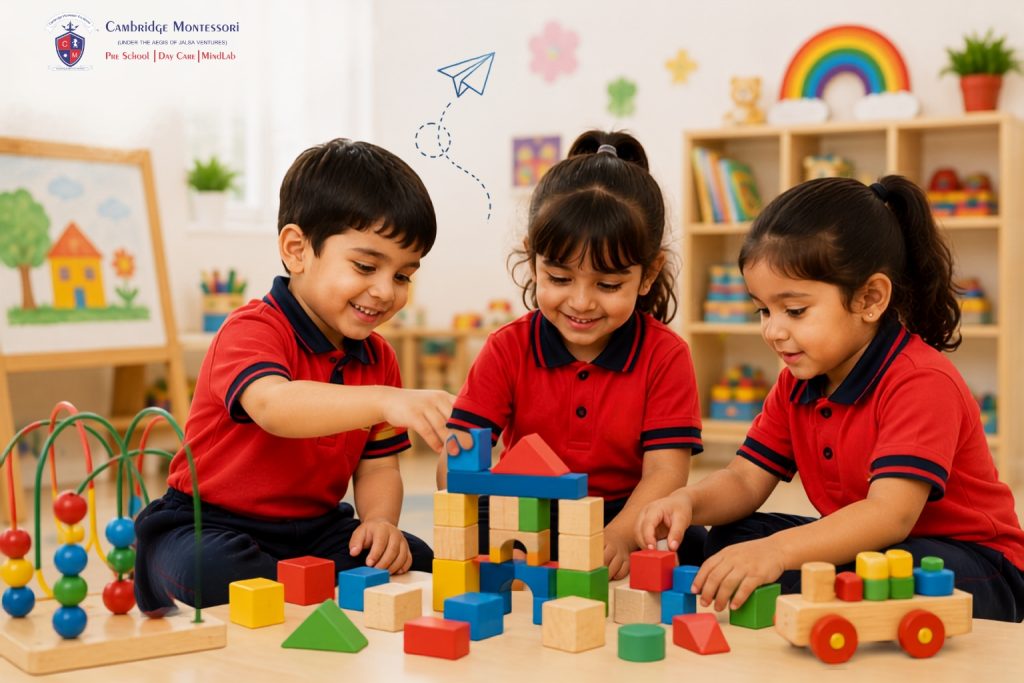
Play at Cambridge Montessori Preschool
Cambridge Montessori Preschool offers play-based learning where play is firmly integrated with academics. The prepared environment offers hands-on materials that encourage young learners to explore. Our mixed-age classrooms encourage children learning from each other, while our educators provide the guidance needed for children to turn play into learning.
This approach which is built on the Montessori method of teaching is firmly supported by modern research – children learn best when they are encouraged to explore and develop their play.
Common Myths About Play and their Explanation
As play is consistently undervalued, there are many myths about play which require to be addressed:
“Play is just entertainment — real learning happens at a desk.” Play actually trains the brain for future academic learning, and supports children’s social and emotional foundations. For children younger than eight, play is the real learning activity.
“Being introduced to academics earlier helps my child.” Introducing children to formal academics earlier, instead of play, can be counterproductive and impact motivation and curiosity negatively. A playful start to learning helps with long-term development
“Educational toys and apps are the best way to learn through play.” Simple props instead of complicated learning materials is often more helpful. Supplies such as blocks, boxes, art supplies and natural objects spark inquisitiveness and boost creativity.
“Play-based activities lead to more chaos with no real learning.” Not really. Play based education can blend with instruction and benefit a child by involving trained educators.
Play Across the Preschool Years
As children grow, their play activities change with their ages.
Younger preschoolers (around 2–3) are involved with sensory and functional play such as exploring textures, pouring, filling, emptying and beginning simple pretend play. Their social play is often solitary or parallel but not with others.
Older preschoolers (around 4–5) begin cooperative pretend play. The play becomes more complicated and ambitious and creativity is supported. The play becomes considerably more social and collaborative, often carried out in teams of players.
During these early years, it is important to follow the child’s lead and let the child work with different playing materials.
The Bottom Line
Play, instead of being viewed as a distraction, is an important part of early childhood learning. Through play, children get headstart to developing their cognitive abilities and develop their social skills. These findings are thoroughly backed by research across several decades.
By providing the children with the right equipment and the freedom to play according to their whims, parents offer their child important learning experiences. We have compiled complete guides to help parents with their child’s play-based learning.
FAQ
Q: Why do children learn through play?
A: Play can help a child experiment and test ideas as well as practice social skills. Play also builds language and mathematical skills and develops children’s cognitive abilities.
Q: What is play-based learning?
A: Play-based learning uses play as a way to develop their skills and enhance their learning. It can range from child-led to guided play in which an adult guides a play to achieve learning goals for the child.
Q: Is play really better than early academics?
A: Research suggests that guided play builds a child’s motivation and social skills better than direct academic learning and also achieves learning outcomes effectively. Play helps in building a good foundation for later learning.
Q: How much play do preschoolers need?
A: Young children need to play in unstructured manner every day, and utilise both the indoor and outdoor environments. Scheduling formal activities at the expense of free play can backfire in terms of lost opportunities to build creative and mathematical skills.