Types of Play in Early Childhood: A Guide for Parents and Teachers
Play can seem to be simple, but in reality, involves several activities which build many skills. By learning about different kinds of play, parents can allow their child to develop holistically.
Here is a guide on the different kinds of play with their many advantages
Two Ways of Understanding Play
Scientifically, play has been categorised based on how social it is and by what cognitive level it seeks to represent.
Parten’s Social Stages of Play
According to the sociologist Mildred Parten, six stages of play have been identified that describe how children’s social play develops (Playworld):
- Unoccupied play— these involve random movements without any purpose (such as by infants).
- Solitary play— this involves playing alone and being absorbed in one’s own play.
- Onlooker play— this involves watching others play without joining in.
- Parallel play— it involves playing besides other children, but not joining them (it is very common in toddlers).
- Associative play— this play involves engaging with others in a sharing and interactive manner, but without a common goal.
- Cooperative play— this involves playing together toward a shared goal, with roles and rules. It is the most socially mature play.
Children play through these various stages as they grow, and all kinds of play can appear at different times. Watching your child play next to rather than with others is not a cause for concern but a normal aspect of play.
Piaget’s Cognitive Stages of Play
According to Jean Piaget, play reflects a child’s thinking (The OT Toolbox) in the following ways:
- Functional / sensorimotor play(0–2) — this involves exploring through the senses and repeated movements (such as shaking a rattle and splashing water).
- Constructive play(roughly 2–7) — this involves utilising objects with the purpose to construct (such as stacking blocks into a tower).
- Symbolic / pretend play— this involves using objects and ideas to mimic other objects (a block becomes a phone).
- Games with rules— this is a structured play which follows defined rules (such as board games and sports).
The Main Types of Play for Your Child
Beyond the above types of play, here are the kinds of play based upon the skills they build in children.
Sensory Play
This involves exploring textures, sounds, tastes, smells and movement by children. This helps in building the neural foundations of future learning and plays a pivotal role for children, and involves playing with water, sand, playdough and the like.
Constructive Play
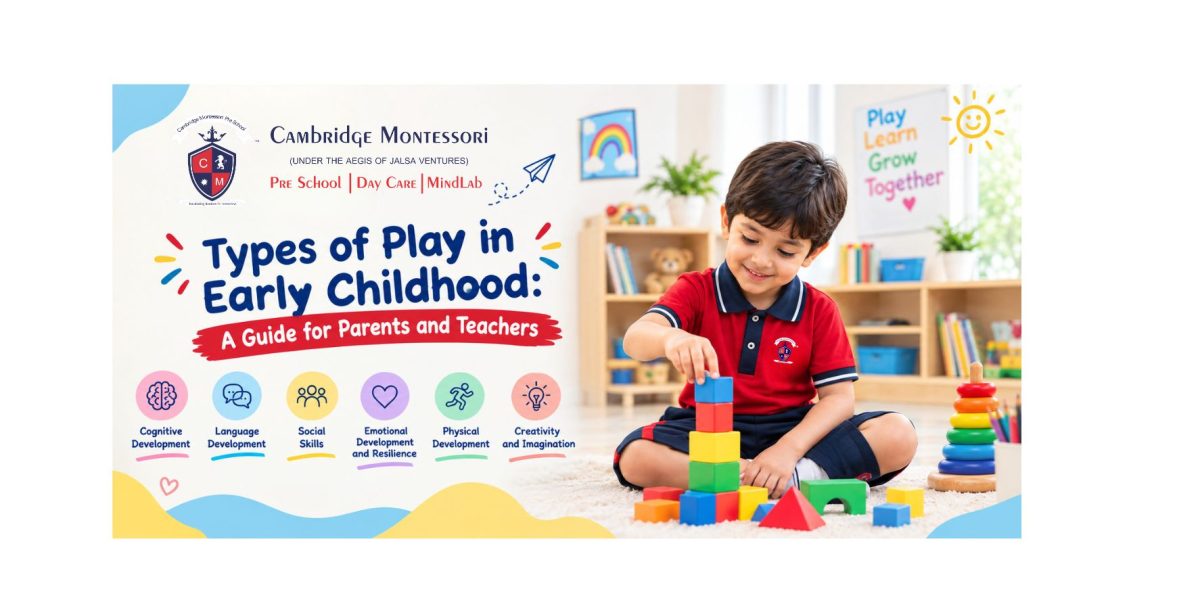
Constructive play involves building with objects such as blocks, LEGO, sand or craft materials. It is instrumental in developing problem solving, spatial reasoning and fine motor skills.
Pretend (Dramatic) Play
Pretend play allows children to enact their imagination. By pretending to be a doctor, a shopkeeper or driving cars, pretend play hones a child’s imagination. It also helps in developing their language and social understanding.
Physical (Active) Play
By actively running, jumping, climbing and dancing, physical play helps in building gross motor skills and health of children. It also helps in building their coordination and social skills. Outdoor play is a kind of physical activity with rich benefits
Creative Play
Creative play involves activities covered by art, music and movements including dance. This play builds a child’s self-expression and imagination, and also builds fine motor skills and emotional development. See Creative Play in Early Childhood.
Games With Rules
By playing structured games with rules, such as board games, card games and cooperative games, children build qualities such as turn-taking, patience and social skills. These games are usually played after the years 4–5.
Structured vs Unstructured Play
Unstructured or free play is play which is entirely led by the child and without any clear rules or goals. It provides unparalleled opportunities for developing creativity and independence for the child. Structured play, on the other hand, has defined rules and objectives and is often enacted under adult guidance and seeks to build specific skills. While children must play both kinds of play, unstructured play is very beneficial and is often the first type of play which children enact.
Why Offering a Range Matters
Different kinds of play build different skills, so ensuring that children experience different kinds of play becomes important. A child who only engages in structured play may not gain the benefits offered by free play, while a child who never experiences pretend play may miss out on its social and communication advantages. By making sure that the right materials and opportunities for every type of play are available, parents can help children develop holistically while allowing them to lead and explore their play. Parents can also explore Our Centres to understand the learning environment and activities offered, and check the admission details when considering a suitable preschool for their child.
The Key Takeaway
“Play” involves several different kinds of play, such as sensory, constructive, pretend, physical, creative and rules-based games. It progresses first through social stages (Parten) and cognitive stages (Piaget) as children age. Each kind of play builds different skills, and therefore a balanced approach to play is important for building different skills through play. To know about the holistic impact of play on children, see Advantages of Play for Growing Children.