Why Mixed-Age Classrooms Work
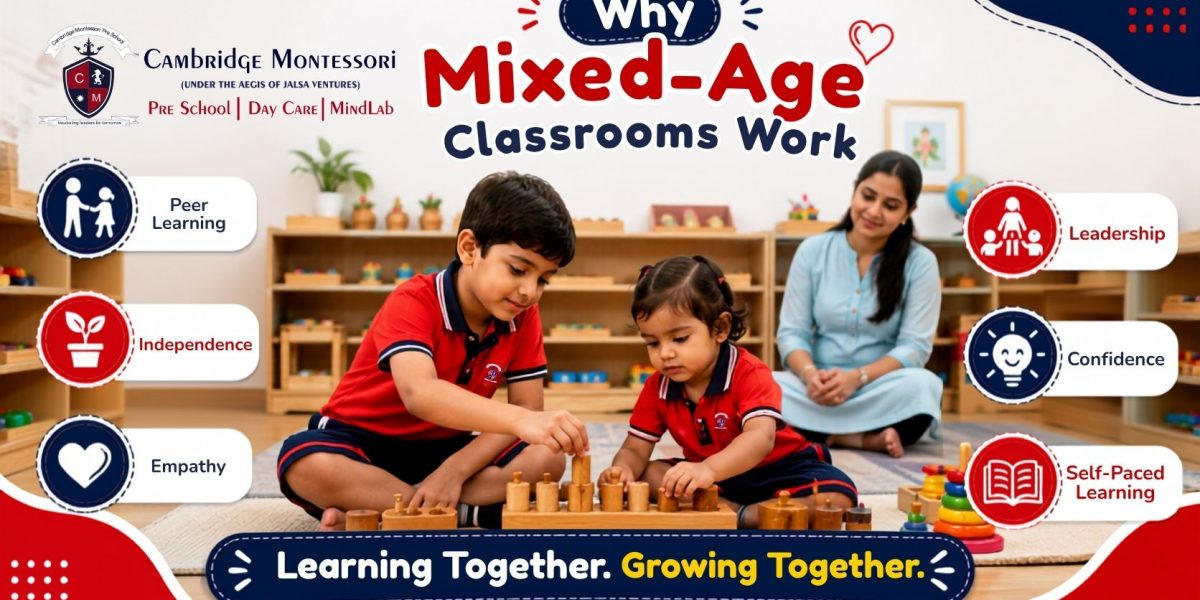
For parents used to the idea of “all the four-year-olds in one room,” a Montessori classroom can look slightly unusual at first. There’s a two-and-a-half-year-old, a four-year-old, and a nearly six-year-old all learning together in the same space—and not by accident. Why mixed age classrooms work is one of the most common questions parents ask when exploring Montessori education. In fact, mixed-age classrooms are one of the most deliberate, research-backed, and often misunderstood features of the Montessori method, designed to encourage peer learning, independence, and social development.
So why do it? It turns out grouping children across a three-year span isn’t a compromise — it’s one of the method’s quiet superpowers. Here’s why it works.
How Montessori Groups Children
A typical Montessori early-childhood class spans roughly ages 2.5 to 6 in a single room. That three-year cycle is intentional — children usually stay with the same class and teacher for all three years, moving from the youngest in the room to the oldest.
This isn’t unique to Montessori philosophy alone. The Association Montessori Internationale describes the prepared environment as organised to support the developmental range of a mixed-age group, with materials displayed for free choice across that whole span. The mix is the design.
Children Learn Beautifully From Each Other
Here’s the first reason it works: a huge amount of learning in a mixed-age room happens child-to-child, not adult-to-child.
An even younger child who observes an older child make a complicated bead chain learns much more than any lecture ever could teach. This is perhaps the most important reason behind the success of mixed ages in Montessori classrooms. They observe possibilities, get inspired, and want to achieve more. The older child becomes an example for them—an example that does not seem intimidating at all because of their age and much more motivating than any worksheet ever could be.
Maria Montessori observed that this peer learning is so central that single-age grouping would undermine the whole method. Decades of practice have borne her out: in a mixed room, knowledge flows constantly and informally between children.
Teaching Is the Best Way to Learn
The second reason cuts the other way. When an older child shows a younger one how to do something — how to pour without spilling, how to form a letter — the older child benefits enormously.
There’s deep truth in the old saying that you don’t really understand something until you teach it. Explaining a concept forces a child to organise their own thinking, fill in their own gaps, and consolidate what they know. The five-year-old patiently helping a three-year-old isn’t losing learning time — they’re cementing their own mastery and building confidence at the same time.
(This article is part of our complete guide: Montessori Education: Everything Parents Need to Know)
It Builds Leadership, Empathy, and Patience
Mixed-age classrooms are natural training grounds for social and emotional skills that single-age rooms simply can’t replicate.
Older children grow into mentors and role models. They learn patience (a three-year-old is slow), empathy (remembering when they couldn’t do it either), and quiet leadership. Younger children, meanwhile, learn to ask for help, watch respectfully, and aspire.
This maps directly onto the social benefits research keeps finding in Montessori. The well-known 2006 study in *Science* found Montessori children showed more advanced social understanding and interacted more positively than peers — and the mixed-age structure is a big part of why. One research review describes how the multi-age classroom, combined with grace and courtesy lessons, supports self-regulation and pro-social behaviour.
It Removes Harmful Competition
In a single-age class, children are often compared—sometimes subtly—to peers who are learning the same skills at the same time. This can lead to unnecessary competition and early labels like “the slow one” or “the bright one.” Why mixed age classrooms work is that they remove this constant comparison.
In a Montessori mixed-age classroom, every child is at a different stage of learning, so there’s no single benchmark for success. Instead, children learn to cooperate, support one another, and celebrate individual progress. This mixed-age learning environment encourages collaboration over competition and reflects real life, where people of different ages and abilities learn and work together every day.
Every Child Gets a Turn to Lead
There’s a lovely structural fairness to the three-year cycle. Every child gets to be the youngest, the middle, and the oldest over their time in the class.
The shy child who spent year one watching becomes, by year three, the confident mentor showing a newcomer the ropes. That full arc — from needing help to giving it — is something a single-age classroom can never offer, because the roles never rotate.
It mirrors the real world.
Step outside the school gates, and you’ll quickly see that the real world isn’t organized by age. Families, workplaces, and communities bring together people of different generations, experiences, and abilities every day. Why mixed age classrooms work is that they prepare children for this reality from an early age. In a Montessori mixed-age classroom, children learn to communicate, cooperate, and build relationships with both younger and older peers. These real-life social experiences help develop confidence, adaptability, and teamwork—skills that benefit them far beyond the classroom.
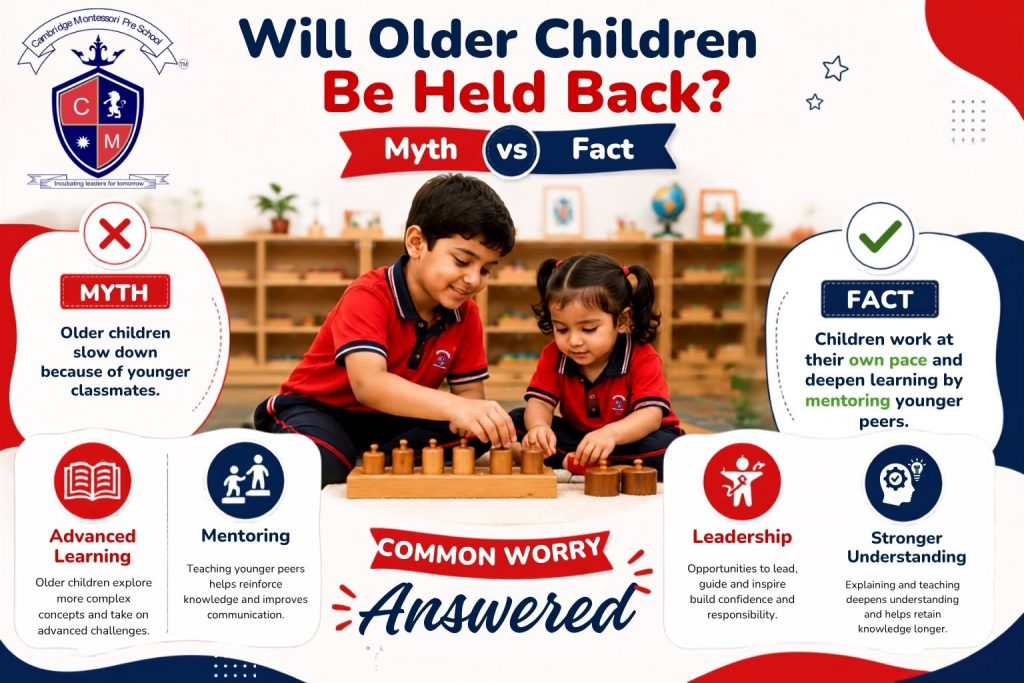
A Common Worry — Answered
Parents sometimes ask: “Won’t my older child be held back by the younger ones?” It’s a fair question, and the answer is no. Because Montessori children work individually with self-chosen materials at their own pace, an advanced child is never slowed to the group’s speed. They press ahead with harder work whenever they’re ready — and gain the bonus of consolidating their knowledge by occasionally helping a younger peer. They get the best of both. (We tackle this and other worries in Common Misconceptions About Montessori Education.)
See It for Yourself
The magic of a Montessori mixed-age classroom is genuinely hard to capture in words—it’s something you feel the moment you watch a six-year-old gently guide a three-year-old’s hand before returning to their own advanced work. Why mixed age classrooms work becomes clear in moments like these, where children learn through kindness, observation, and collaboration. This unique Montessori learning environment nurtures confidence, leadership, empathy, and independence, helping every child grow academically and socially at their own pace.
Book a visit to a Cambridge Montessori Preschool center near you and watch a mixed-age community in action. It might just change how you think about classrooms altogether.
Frequently Asked Question (FAQ’s)
Q1. What is a mixed-age classroom in Montessori?
Ans. A mixed-age classroom is a learning environment where children of different ages, usually between 2.5 and 6 years, learn together. Instead of separating children by age, Montessori classrooms encourage them to learn from one another while progressing at their own pace.
Q2. Why does Montessori use mixed-age classrooms?
Ans. Montessori uses mixed-age classrooms because children learn naturally by observing, helping, and working with peers of different ages. This approach builds independence, confidence, leadership, and social skills while creating a supportive learning community.
Q3. What are the benefits of mixed-age learning for younger children?
Ans. Younger children benefit by observing older classmates, which motivates them to try new activities and develop new skills. They also gain confidence, improve communication, and learn classroom routines in a calm and encouraging environment.
Q4. How do older children benefit from mixed-age classrooms?
Ans. Older children strengthen their own understanding by guiding younger classmates. They develop leadership, patience, empathy, responsibility, and communication skills, all of which prepare them for future learning and real-life situations.
Q5. Will my older child be held back in a mixed-age Montessori classroom?
Ans. No. Montessori children work with learning materials based on their individual ability, not their age. Older children continue learning advanced concepts while also gaining valuable leadership experience by occasionally helping younger classmates.
Q6. How do mixed-age classrooms reduce competition?
Ans. Since every child is working on activities suited to their own developmental stage, there is less comparison between classmates. Children focus on their personal progress rather than competing with others, creating a positive and cooperative learning environment.
Q7. What age groups are included in a Montessori classroom?
Ans. Most Montessori early childhood classrooms include children between 2.5 and 6 years of age. Children usually stay in the same classroom for three years, allowing them to experience being the youngest, middle, and oldest member of the community.
Q8. Do mixed-age classrooms improve social skills?
Ans. Yes. Mixed-age classrooms help children develop empathy, patience, teamwork, respect, and effective communication. Daily interactions with younger and older peers naturally strengthen their social and emotional development.
Q9. How does peer learning work in Montessori classrooms?
Ans. Peer learning happens when children observe, collaborate with, and help one another during classroom activities. Younger children learn by watching older classmates, while older children reinforce their own knowledge by explaining concepts and demonstrating skills.
Q10. Are mixed-age Montessori classrooms better than traditional classrooms?
Ans. Both approaches have their strengths, but mixed-age Montessori classrooms offer unique benefits such as individualized learning, peer mentoring, leadership development, and reduced competition. Many parents choose Montessori because it supports both academic growth and social-emotional development in a natural way.