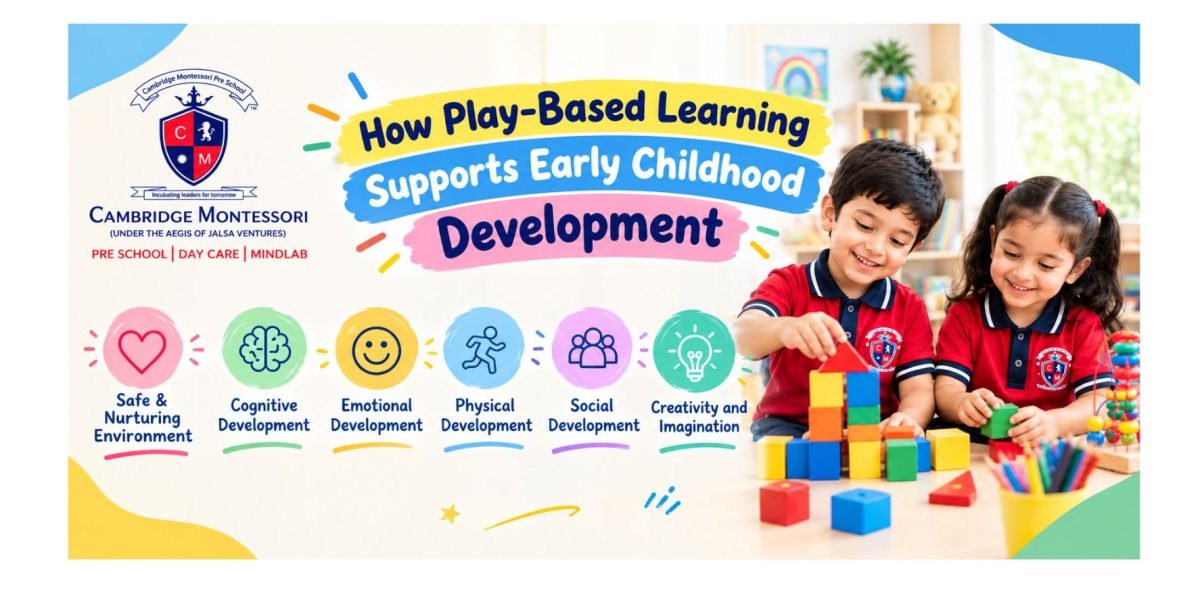
How Play-Based Learning Supports Early Childhood Development
“Play-based learning” has become a very popular phrase in education. This article explains the rationale and research that supports play-based learning.
What Is Play-Based Learning?
Play-based learning is a learning method in education where play is medium for young children’s academic learning. Rather than organising children for formal education, it utilises their natural inclination to play as an engine of academic learning.
Adopting play-based learning does not mean that the role of the teacher is diminished. Rather, it emphasises the role of the education in making children learn through play-based activities. It ranges from free play – which is fully child-led, to guided play – which is also child-led but guided by an adult educator towards achieving a learning goal.
Backed by Research
The benefits of play-based learning are well established by research.
Based on a clinical report from the American Academy of Paediatrics, play is known to enhance the brain structure as well as executive function (Yogman et al., 2018). A LEGO Foundation review gathered meaningful evidence that children learn best from joyful, engaging and socially interactive play (Zosh et al., 2017). The U.S. Department of Education’s research wing also found that for children younger than eight, guided play achieved better academic outcomes that direct instruction (IES), thereby supporting the view that play scientifically advances academic learning.
How Play Promotes Holistic Development
Play-based learning helps in developing many functions for the child, as mentioned below.
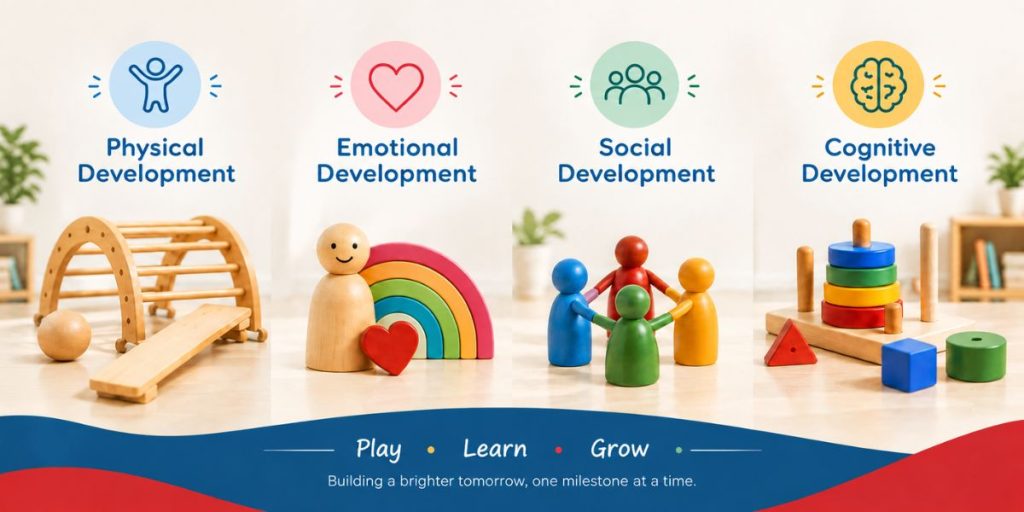
Cognitive Development
Play encourages the development of thinking skills such as problem-solving, memory and literacy and numeracy. As children are deeply invested in play, their learning is deep and lasting.
Social Development
Playing with peers encourages children to learn how to share, take turns, lead, follow and resolve conflicts, and greatly builds their social skills naturally through the engagement that play demands, especially through mixed-age play and group play.
Emotional Development
Through play, children better their self-regulation and learn to process their emotions. Play helps in developing their resilience and confidence, while pretend play helps children in navigating their fears and emotions in a safe manner. This is explored in in How Play Helps Children Develop Social and Emotional Skills.
Physical Development
Play leads to the refinement for both gross motor skills such as running and balancing, as well as fine motor skills such as grasping and drawing. These skills also help in developing their future skills in sports and handwriting.
Free Play vs Guided Play
According to research, both free play and guided play are important and for different reasons.
Free play, which is entirely initiated and led by child, builds their creativity, independence and social skills, because children themselves entirely guide the play and build their leadership abilities.
Guided play, on the other hand, brings in the experience and expertise of adult educators and parents, and support the child in achieving academic outcomes in a play-based manner. It is supported by research to achieve and accelerate learning, because it maintains the independence and creativity of the children while letting them be guided by the adults (NAEYC).
The balance between free play and guided play is essential because it balances the child’s freedom and learning. This is exactly the goal behind the Montessori method of learning.
What This Looks Like in Practice
In a play-based setting, the child selects his or her own activities from carefully prepared materials while the educator intervenes to guide or gently nudge the child to help the child learn effectively from manipulating the materials. This encourages hands-on exploration with the play materials and also is joyful for the child, unlike traditional learning which is very structure and routine. Every activity of the play is designed to build specific skills for the child.
The Key Takeaway
Play-based learning works with children’s natural inclination to play, explore, and make sense of the world around them. Research supports both free and guided play as effective ways to develop children’s cognitive, social, and emotional abilities. Guided play can also support learning outcomes more effectively than traditional instruction in many areas.
At our centres, we integrate play-based experiences into everyday learning, giving children opportunities to explore, discover, interact, and develop essential skills in a meaningful way. These experiences support holistic development while making learning enjoyable and purposeful.
Admissions are now open at our centres for children ready to learn, explore, and grow through meaningful early childhood experiences.
To understand this more, refer to our pillar guide, The Role of Play in Early Childhood Education .
FAQ’s ( Frequently Asked Question )
Qus: What skills does play-based learning help children develop?
Ans: Play-based learning supports a wide range of skills, including communication, creativity, problem-solving, decision-making, cooperation and emotional regulation. It also helps children develop physical and cognitive abilities through active exploration and interaction.
Qus: How does play-based learning support social development?
Ans: Playing with other children gives them opportunities to communicate, share, take turns and work together. Through these everyday interactions, children learn how to build relationships, understand others and manage social situations.
Qus: How does play-based learning support emotional development?
Ans: Play gives children a comfortable environment where they can express their feelings, explore different situations and learn how to respond to them. It can help children develop confidence, empathy and better emotional regulation.
Qus: Can play-based learning improve a child’s problem-solving skills?
Ans: Yes. Play naturally gives children small challenges to solve. Building with blocks, completing puzzles, creating games or finding different ways to use materials encourages children to experiment, make decisions and learn from their experiences.
Qus: What role does a teacher play in play-based learning?
Ans: In play-based learning, the teacher acts as a facilitator rather than simply delivering instructions. Teachers observe children’s interests, provide suitable resources, ask questions and offer gentle guidance when it can support the child’s learning.
Qus: Can play-based learning be used to teach subjects like maths and language?
Ans: Yes. Play can be used to introduce and reinforce concepts in areas such as early maths, language, literacy and science. For example, counting games can introduce numbers, while storytelling and pretend play can support vocabulary and communication skills.
Qus: Is play-based learning suitable for all young children?
Ans: Play is a natural part of early childhood, and play-based learning can be adapted to suit different ages, interests and stages of development. The activities and level of adult guidance can change according to what children are ready to explore and learn.
Qus: How can parents encourage play-based learning at home?
Ans: Parents can support play-based learning with simple activities such as storytelling, drawing, building blocks, pretend play, puzzles, sorting games and outdoor exploration. Giving children time to explore independently is just as important as joining them in play.
Qus: Why is play important in early childhood development?
Ans: Play allows children to learn through exploration, experimentation and interaction rather than simply receiving information. It supports their social, emotional, cognitive and physical development while helping them make sense of the world around them.