Montessori Education Guide: Everything Parents Need to Know
If you’ve started looking at preschools, you’ve almost certainly come across the word “Montessori.” It’s on signboards, in brochures, and at the top of every parenting WhatsApp group debate. This Montessori education guide exists because so few of those signboards explain what the word actually means. But ask ten people what it actually means and you’ll get ten different answers — “it’s the one with wooden toys,” “it’s where kids do whatever they want,” “it’s expensive.”
None of those quite capture it. So let’s slow down and do this properly. This Montessori education guide walks you through what Montessori really is and how it works day to day. It also covers what the research says, and how to tell a genuine Montessori environment from one that just borrows the name. Wherever a section deserves a deeper dive, we’ll point you to a full article on that topic.
Think of this as the map. The detailed walking tours come later.
Montessori Education: A Method, Not a Brand
Montessori isn’t a franchise or a trademark in the way most people assume. It’s an educational approach developed more than a century ago by Dr. Maria Montessori, Italy’s first female physician, who began by observing how children actually learn rather than how adults assume they should.
What she noticed changed education forever: given the right environment and genuine freedom to choose their work, young children don’t descend into chaos. They concentrate — often for far longer than anyone expected — and they teach themselves with remarkable focus. The Montessori method is essentially a system built around that single insight.
Because the name was never tightly protected, almost any school can call itself “Montessori.” That’s exactly why understanding the real principles matters so much for parents — it’s your only reliable filter. We have a dedicated explainer on What Is Montessori Education?
The Core Principles That Define a Montessori Classroom
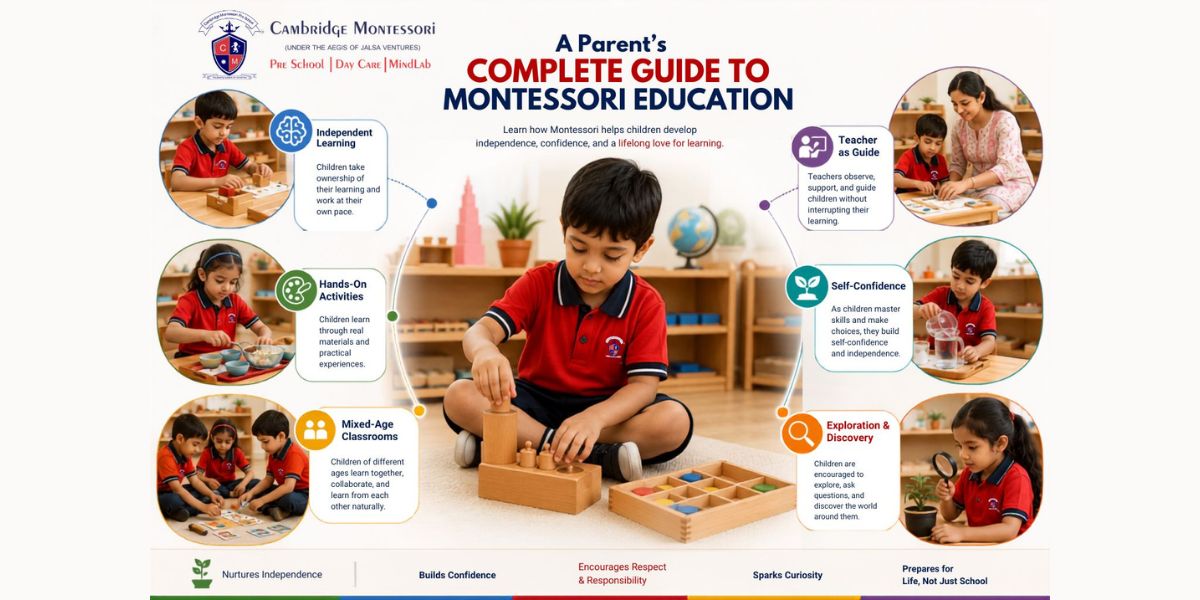
Forget the marketing. A real Montessori classroom rests on a few clear ideas. T
groups them into a few core components worth knowing before you tour any school.
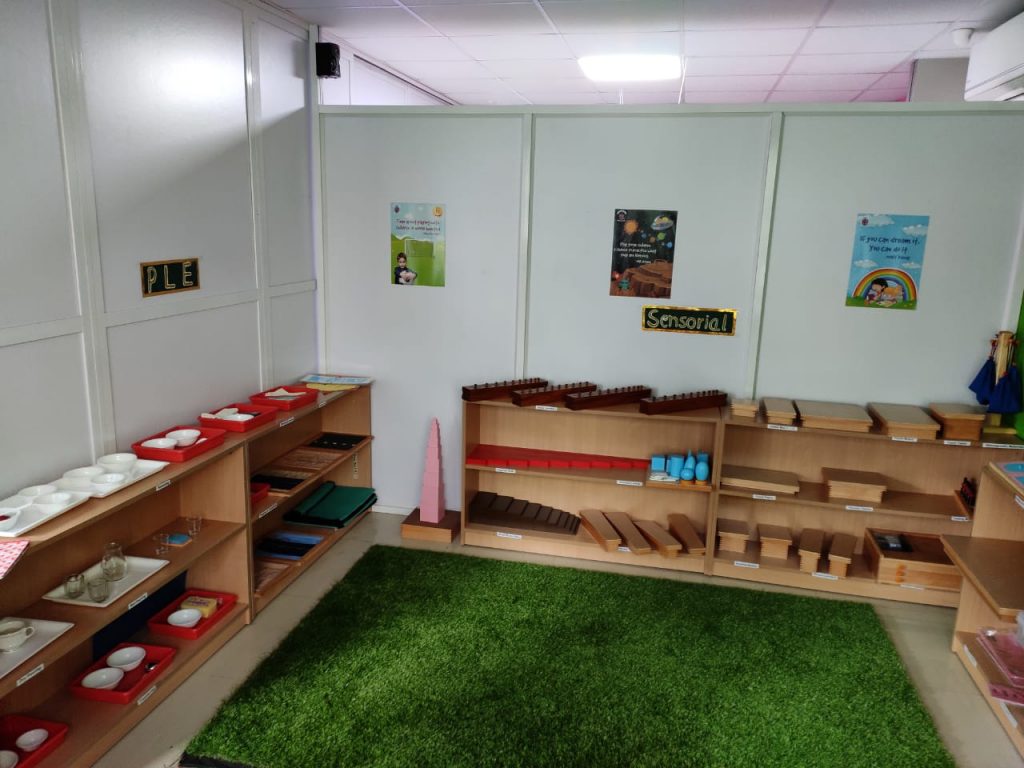
The prepared environment. A Montessori classroom is deliberately designed. Child-sized furniture, materials arranged in order on low open shelves, and everything within reach. Nothing is accidental. The room itself is the teacher’s most important tool. It is set up so children can work on their own, without constantly needing an adult.
Hands-on, self-correcting materials. Instead of worksheets, children work with beautifully made physical materials—sandpaper letters, bead chains for counting, and the famous pink tower. Many are self-correcting, meaning the child can see and fix their own mistake without a teacher marking it wrong. That quietly builds confidence and independence at the same time.
More Montessori Principles to Know
Freedom within limits. Children choose what to work on and for how long, but within clear, consistent boundaries. They’re free to pick any activity they’ve been shown — as long as they use it respectfully and return it for the next child. It’s structured freedom, not a free-for-all.
Uninterrupted work periods. Rather than chopping the morning into 20-minute slots, Montessori protects long blocks of time so children can reach deep concentration. This single feature is one of the method’s quiet superpowers.
Mixed-age classrooms. Children aren’t sorted into rigid single-year groups. A typical early-childhood class spans roughly ages 2.5 to 6, and that mix is intentional—younger children learn by watching, and older children deepen their understanding by helping.
The teacher as guide. The adult doesn’t stand at the front and lecture. They observe each child closely, then introduce the right material at the right moment — what Montessori called meeting the child’s “sensitive periods,” the windows when a child is biologically primed to absorb a particular skill like language or order.
What a Montessori Morning Actually Looks Like
Theory is one thing; picture the room. For instance, a three-year-old is carefully spooning lentils from one bowl to another, tongue out in concentration. Nearby, a five-year-old is laying out a long chain of golden beads to explore what 100 really means. Meanwhile, two children are quietly washing a table together. Another child traces sandpaper letters with a fingertip. She feels the shape of an “s” before she is ever asked to write it.
There are no bells, no rows of desks, and no teacher calling for everyone’s attention. Instead, there is a calm hum of children doing work they chose themselves. It can look almost too relaxed to a newcomer. But every single activity is building motor control, concentration, or independence by design.
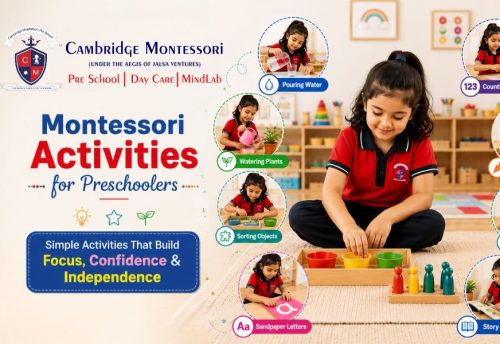
Those everyday activities are more deliberate than they appear, and we break down the best ones—including ones you can try at home—in Montessori Activities for Preschoolers.
Does Montessori Actually Work? What the Research Says
This is the question that matters most, and parents deserve evidence rather than slogans. The good news: Montessori is one of the more rigorously studied educational methods, and recent research is genuinely strong.
The landmark finding came in October 2025, when the Proceedings of the National Academy of Sciences published the first national randomized controlled trial of public Montessori preschool. Professor Angeline Lillard led the study at the University of Virginia. It tracked 588 children. It compared those who won a random lottery for a Montessori place against those who applied but didn’t get in. Because a lottery assigned the places, the study could isolate the effect of Montessori itself rather than the kind of family that seeks it out.
By the end of kindergarten, the children who attended Montessori showed significantly better outcomes in reading, executive function, short-term memory, and social understanding — and the approach cost districts thousands less per child. Notably, lower-income children showed the strongest advantages. This suggests Montessori can help level the playing field rather than widen it.
This built on the well-known 2006 study in Science, where Lillard and Else-Quest studied Montessori children. The children outperformed their peers in reading and math. They also played more cooperatively and showed more advanced social reasoning and self-control.
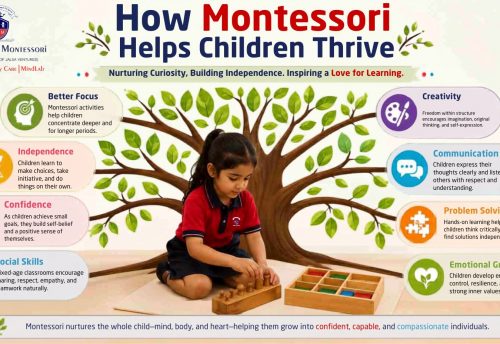
We pull all of this together—minus the academic jargon — in The Benefits of Montessori Learning
How Montessori Grows With Your Child
One thing that surprises many parents: Montessori isn’t only a preschool idea. This part of the Montessori education guide covers how the method grows with a child. Maria Montessori designed her approach around distinct developmental stages. She called them “planes of development” — each with its own needs and its own kind of classroom.
In the early years (roughly 2.5 to 6), the focus is on the senses, movement, language, and practical independence — the stage most parents picture when they think “Montessori.” Montessori described this age as having an “absorbent mind,” soaking up everything from the environment almost effortlessly. This is the window where the prepared environment and hands-on materials do their most powerful work.
In the elementary years (around 6 to 12), the child’s mind shifts from absorbing to reasoning. The questions become “why?” and “how?”, and Montessori classrooms respond with big, interconnected lessons that link history, science, geography, and maths into one grand story. Many Montessori schools continue right through these years and beyond.
For most families choosing a preschool, the early-years classroom is the starting point — but it helps to know the method is a coherent arc, not a one-off phase. The foundations of focus and independence built at three are the same ones that serve a curious ten-year-old.
Independence: Montessori Education’s Quiet Goal
If there’s one word that captures what Montessori is really for, it’s independence. Maria Montessori’s famous guiding phrase was, in essence, to help the child do it themselves.
Every design choice serves this. For example, low shelves let children fetch and return their own materials. Real, child-sized tools — actual little jugs, brooms, and buttons — let them care for themselves and their space. Likewise, a teacher is trained to step back. They let a child struggle productively instead of rushing in to rescue them.
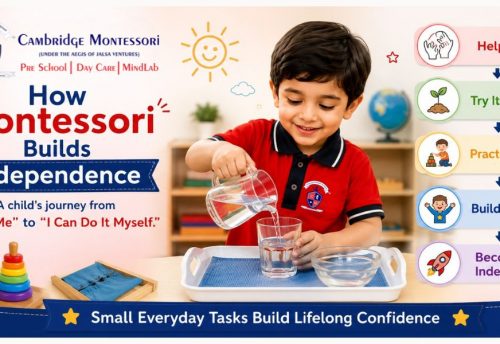
The payoff isn’t just a child who can pour their own water. It’s a child who learns, deep in their bones, “I am capable. I can figure things out.” That self-belief is arguably the most valuable thing any preschool can hand a four-year-old. As highlighted in this Montessori Education Guide, independence is one of the cornerstones of Montessori learning, and we explore exactly how it is built, step by step, in How Montessori Builds Independence.
Montessori Education and India’s New Foundational Stage
For Indian parents, there’s a timely reason this Montessori approach is getting fresh attention. India’s National Education Policy (NEP) 2020 restructured schooling around a new 5+3+3+4 system, and its Foundational Stage — covering ages 3 to 8 — explicitly calls for flexible, play-based, activity-based, and experiential learning.
If that sounds familiar, it should. Those are precisely the principles Montessori has practiced for over a hundred years. The policy also leans on a well-established truth: more than 85% of a child’s brain development happens before the age of six, which is exactly why the early years carry such weight. In many ways, NEP 2020 has brought national policy into line with what Montessori educators have long believed about how young children learn best.
Clearing Up Montessori Education Myths
Because Montessori is so often misunderstood, plenty of myths get in the way of good decisions. “It’s only for rich families.” “Children just do whatever they want.” “There’s no structure, no real learning, no fun.” “It can’t prepare a child for a normal school later.”
Each of these has a clear, evidence-based answer — and believing them can cause parents to rule out an option that might suit their child beautifully. We tackle them head-on in Common Misconceptions About Montessori Education.
How to Choose a Genuine Montessori Preschool
Since any school can use the name, the final step in this Montessori education guide is here’s a practical checklist for your school visits:
- Watch the children, not the brochure. Are they moving freely, choosing their own work, and concentrating? Or sitting in rows being talked at?
- Look for real Montessori materials on low, open, orderly shelves — not just wooden toys scattered about for show.
- Ask about the age range in each class. Genuine programs use mixed-age groups, not single-year batches.
- Ask about teacher training. A trained Montessori guide is the difference between the real method and a decorated imitation.
- Notice the noise and the pace. A real Montessori room is calm and purposeful, with long uninterrupted work time — not constant whole-class instruction.
A Word on Cambridge Montessori Preschool
At Cambridge Montessori Preschool, every one of these principles is the starting point, not an afterthought. Our classrooms are genuinely prepared environments; materials are authentic and self-correcting, and groups are mixed-age by design. And our educators are trained to guide rather than dictate. so that independence, concentration, and a real love of learning have room to grow.
If you’d like to see the difference in person rather than just read about it, book a visit to your nearest Cambridge Montessori Preschool center and watch a Montessori morning unfold for yourself.
The Bottom Line on This Montessori Education Guide
Montessori education isn’t a trend or a marketing label. In short, this Montessori education guide comes down to one idea. It’s a coherent, century-old, research-backed approach. It rests on a simple respect for how children actually learn: through hands, through choice, through concentration, and through the satisfaction of doing things for themselves.
One of the key takeaways from this Montessori Education Guide is that the method focuses on nurturing independence, confidence, curiosity, and a lifelong love for learning rather than simply preparing children to memorize facts. The goal is to help children become capable, responsible, and self-motivated learners.
It won’t be the perfect fit for every single family — no method is. But for parents who want their child to leave preschool not just knowing their letters but believing in their own capability, Montessori deserves a serious look. Whether you’re just beginning your research or comparing different preschool approaches, this Montessori Education Guide can help you better understand what makes Montessori education unique.
Start with the deeper dives linked throughout this guide, visit a few real classrooms, and trust what you see in the children’s faces. That, more than any brochure, will tell you everything you need to know about Montessori education and whether it is the right choice for your child.
FAQ’s (Frequently Asked Question)
Q1: What age is best to start Montessori?
Ans: Most Montessori early-childhood programs begin around age 2.5 to 3, aligning with a period of rapid brain development and natural readiness for independence.
Q: Is Montessori good for children who are very active or easily distracted?
Ans: Often, yes. The freedom of movement, hands-on materials, and long uninterrupted work periods suit active children who struggle to sit still in conventional classrooms, and research links Montessori with stronger executive function and self-regulation.
Q3: Will my child cope in a regular school after Montessori?
Ans: Generally, very well. Montessori children typically transition with strong independence, focus, and academic foundations. (We cover this fully in our misconceptions article.)
Q4: Is Montessori aligned with India’s NEP 2020?
Ans: Closely. NEP 2020’s Foundational Stage emphasizes play-based, activity-based, and experiential learning for ages 3–8 — the same principles Montessori has used for over a century.
Q5: What skills do children develop in a Montessori preschool?
Ans: Children in a Montessori preschool develop a wide range of skills, including independence, communication, social interaction, critical thinking, fine motor coordination, problem-solving, and self-discipline. The Montessori method also helps children build confidence and a lifelong love for learning through hands-on experiences. This wraps up our Montessori education guide—but each linked article above goes much deeper.