How Preschool Helps Build Communication and Social Skills
How Preschool Helps Build Communication and Social Skills begins with everyday interactions that shape a child’s future. Watch a three-year-old negotiate whose turn it is on the slide, and you’re watching something remarkable: a brain learning to communicate, compromise, and connect. These moments are not a side benefit of preschool—they are the point. Research from MIT found that back-and-forth conversations between adults and young children physically change the brain, with the number of “conversational turns” predicting language skills more strongly than the sheer number of words a child hears. Preschool is, quite simply, where those meaningful conversations multiply, helping children develop stronger communication abilities, social confidence, and lifelong interpersonal skills.
Why Social Skills Matter More Than You Think
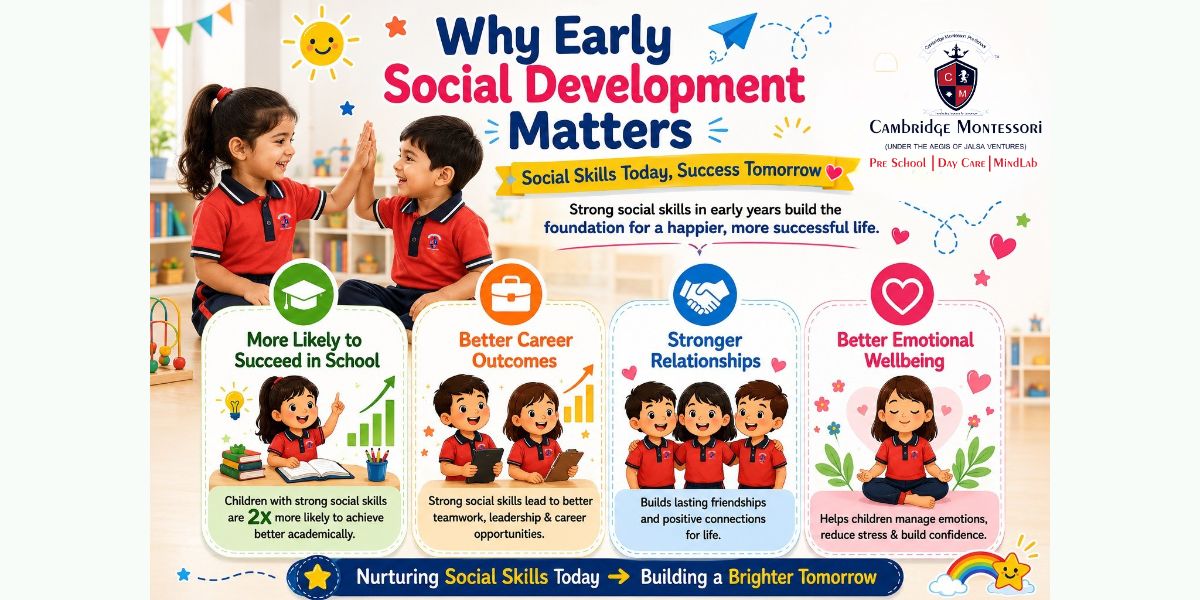
A remarkable 20-year study published in the American Journal of Public Health followed over 700 children from kindergarten into adulthood. Children with stronger social skills at age five were 54% more likely to finish school on time, twice as likely to earn a college degree, and 46% more likely to hold a full-time job by 25 (Jones et al., 2015). Social skills development in early childhood, in other words, predicts life success more reliably than early academics do.
This is what makes preschool different from home. At home, a parent often anticipates a child’s needs before they’re spoken. At preschool, children must use words — to ask for materials, explain a problem, or tell a story at circle time. These daily interactions show how preschool helps build communication and social skills, as dozens of small conversational exchanges each day, with teachers and peers, do exactly what the MIT research describes: build the brain’s language architecture through genuine dialogue.
Where the Learning Actually Happens
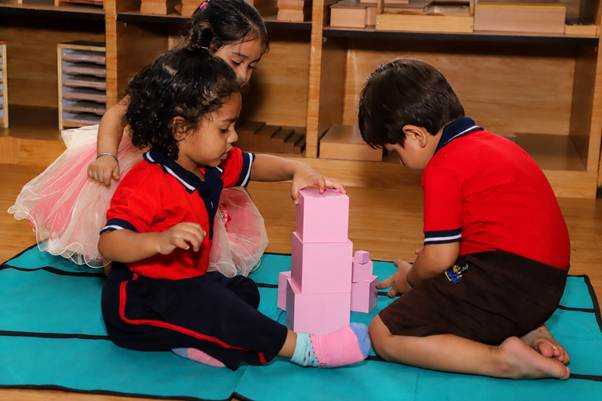
It happens in group activities first. Story circles, music sessions and shared projects teach children to listen when others speak, wait their turn, and contribute ideas — the first experience of being part of something bigger than themselves.
It happens through friction, too. Sharing isn’t natural at age two; it’s learned. Preschool gives children daily, gently supervised practice at dividing materials, resolving small conflicts, and discovering that cooperation makes play more fun. First friendships follow, and with them, the foundations of empathy. And every time a child speaks at circle time, asks for help, or shows a friend how to complete a puzzle, they collect a small proof: my voice matters. That accumulating confidence is what carries children into primary school ready to participate, not just attend.
Behind all of it sit the teachers. Trained early-years educators model conversation — they get down to eye level, ask open questions (“What do you think happens next?”), and help children name emotions, demonstrating how preschool helps build communication and social skills in everyday classroom interactions. The research is consistent that this adult-child interaction is the engine of development, which is why a quality preschool invests so heavily in its educators.
The Montessori Advantage
The Montessori method has unusually strong evidence on social outcomes specifically. The landmark Lillard study in Science (2006) found Montessori children showed more positive playground interaction and more advanced social cognition than peers, and a 2025 national randomised trial in PNAS confirmed better social understanding at the end of kindergarten. Mixed-age classrooms are a key reason: younger children learn by watching older ones, and older children grow by mentoring them.
Signs Your Child Is Developing Strong Social Skills
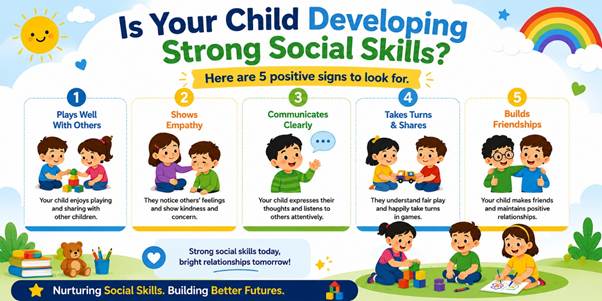
- They talk about friends by name and look forward to seeing them
- They can take turns with less prompting
- They express feelings in words rather than only tears or tantrums
- They show concern when another child is upset
- They initiate play and invite others to join
If you’re noticing these at home, preschool is doing its job. If you’re still choosing a preschool, look for them in the classrooms you visit: watch how teachers speak with children, whether ages mix, and whether children talk to each other or only to adults. At Cambridge Montessori Preschool, classrooms are built around exactly these principles — child-led communication, mixed-age interaction and trained educators — because the social skills your child builds now will outlast every worksheet.
References
- Romeo, R. et al. (2018). Beyond the 30-Million-Word Gap. Psychological Science / MIT McGovern Institute (news.mit.edu)
- Jones, D. E., Greenberg, M. & Crowley, M. (2015). Early Social-Emotional Functioning and Public Health. American Journal of Public Health, 105(11). DOI: 10.2105/AJPH.2015.302630
- Lillard, A. & Else-Quest, N. (2006). Evaluating Montessori Education. Science, 313(5795)
- Lillard, A. S. et al. (2025). A national randomized controlled trial of public Montessori preschool. PNAS. DOI: 10.1073/pnas.2506130122
Frequently Asked Questions (FAQs)
1. What is the ideal age for a child to start preschool?
Most children are ready for preschool between 2.5 and 3.5 years of age. However, preschool readiness depends on factors such as communication skills, curiosity, social interaction, and the ability to spend short periods away from parents.
2. How can I tell if my child is ready for preschool?
Some common signs of preschool readiness include following simple instructions, expressing basic needs verbally, showing curiosity about the world, interacting with other children, and managing brief separations from parents without significant distress.
3. What are the benefits of Montessori preschool education?
Montessori education encourages independent learning, problem-solving, creativity, and self-confidence. Children learn at their own pace through hands-on activities, helping them develop academic, social, and emotional skills in a supportive environment.
4. How can parents prepare their child for preschool at home?
Parents can support preschool readiness by reading with their child daily, establishing consistent routines, encouraging independence through small responsibilities, practicing short separations, and providing opportunities for social interaction with other children.
5. What should parents look for when choosing a preschool?
When selecting a preschool, consider factors such as qualified teachers, child-to-teacher ratios, safety measures, learning environment, curriculum approach, communication with parents, and whether the school supports the overall development of the child through age-appropriate activities and experiences.