Montessori Activities for Preschoolers
One of the loveliest things about the Montessori method is that you don’t need a classroom—or a single expensive toy—to start. Many of the most effective Montessori activities for preschoolers use everyday items already sitting in your kitchen. These simple, hands-on experiences help children build independence, concentration, and confidence while turning ordinary moments into meaningful learning opportunities.
Below are practical, age-appropriate activities you can set up at home, grouped the way a Montessori classroom organizes them. Each one looks simply. Each one quietly builds focus, coordination, independence, and early academic skills at the same time.
A Few Principles Before You Start
Montessori activities work best when you respect a few simple rules:
- Keep it real. Montessori favours real, child-sized tools over plastic pretend ones — an actual little jug rather than a toy teapot.
- Show, don’t tell. Demonstrate slowly and silently first, then let your child try. Resist narrating every step.
- Let them repeat. If your child does the same activity twenty times, that’s not boredom — it’s deep learning. Don’t interrupt it.
- Embrace the mess. Spills are part of it. Hand them a small cloth and let them clean up; that’s part of the activity too.
- Step back. The goal is for them to do it, even slowly and imperfectly.
Practical Life Activities
These are the heart of Montessori for young children. The American Montessori Society describes practical life as how children learn to care for themselves and their environment — and they build concentration and fine motor control that later feed directly into writing and maths.
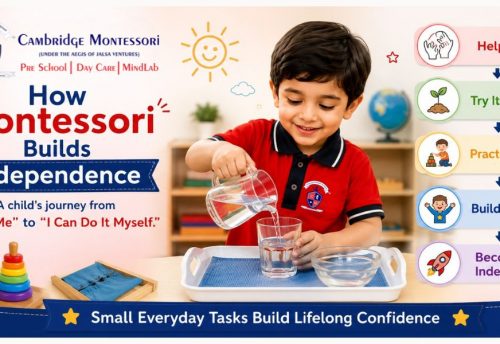
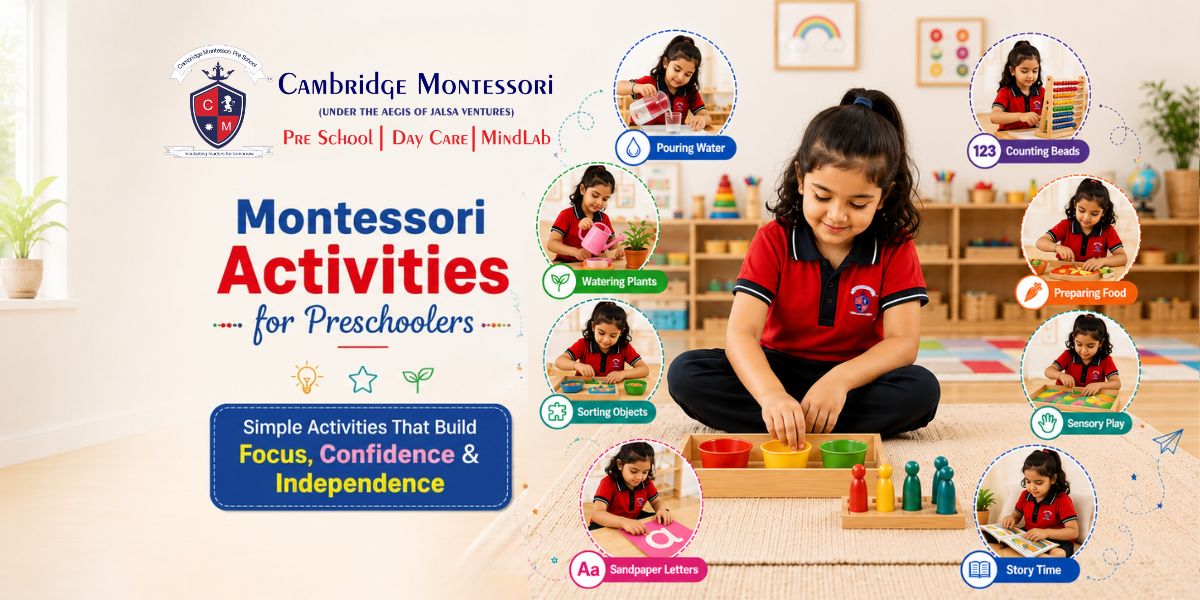
Spooning and pouring. Set out two small bowls, one with dry lentils or rice, and a spoon. Let your child transfer the contents from one bowl to the other, then back. Graduate to pouring water between two small jugs. Simple, absorbing, and brilliant for hand control.
Buttoning, zipping, and lacing. An old shirt, a jacket with a zip, or a shoe to lace. These “dressing” tasks build the exact finger strength and coordination children need — while teaching them to dress themselves.
Food preparation. Let your child spread butter on toast, peel a banana, wash vegetables, or tear lettuce for dinner. Real, useful work is endlessly motivating for small children.
Care of the environment. A small cloth for wiping the table, a little broom for sweeping, a watering can for the plants. Children genuinely love caring for their space when given the right-sized tools.
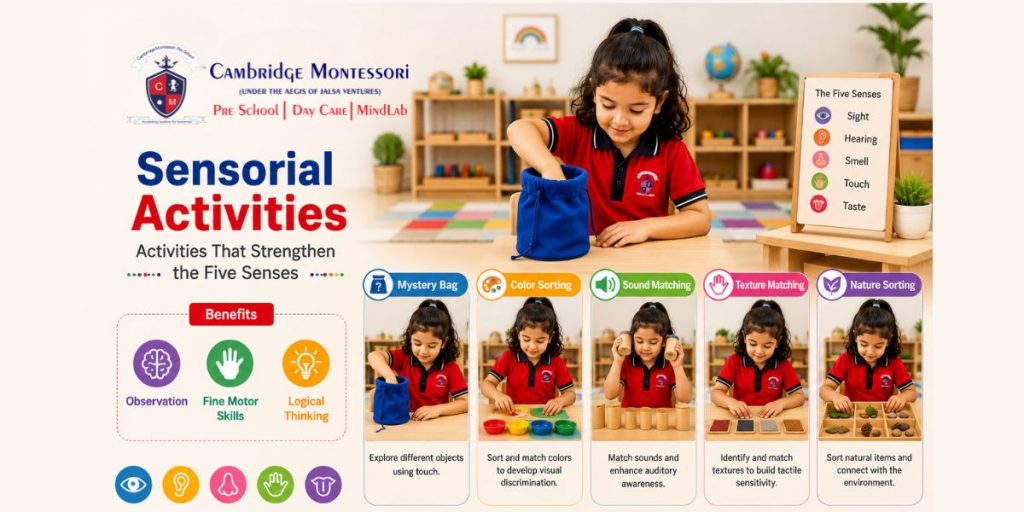
Sensorial Activities
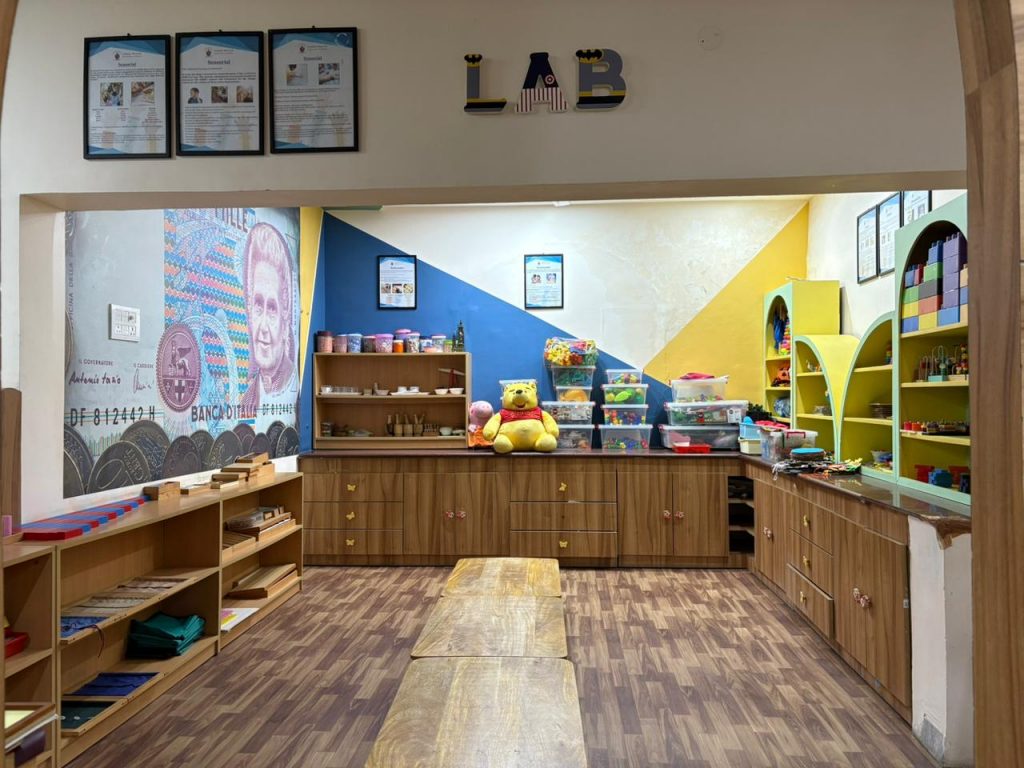
Montessori sensorial work refines the senses and lays a foundation for language and maths. The classic classroom materials are scientifically designed, but you can capture the spirit at home.
Mystery bag. Put several familiar objects (a spoon, a ball, a small toy) in a cloth bag. Your child reaches in and tries to identify each by touch alone. Wonderful for vocabulary and tactile discrimination.
Sorting by colour, size, or texture. Buttons, beads, leaves, fabric scraps — anything that can be grouped. Sorting builds the early logical thinking that underpins maths.
Sound matching. Fill small identical containers in pairs with different fillings (rice, beans, coins) and let your child shake and match them by sound.
Language Activities
Montessori builds toward reading and writing through the senses and sounds first — never through pressure.
Sandpaper-style letters. Trace letters cut from rough paper (or drawn in a tray of sand or rava) while saying the sound the letter makes, not its name. Children feel and hear the letter before ever being asked to write it.
“I spy” with sounds. “I spy something that starts with mmm.” This playful game builds phonological awareness — the single best predictor of early reading — without a worksheet in sight.
Rich conversation and storytelling. The most underrated language activity of all. Talk to your child constantly, name things precisely, read together daily, and let them tell you stories back.
Early Maths Activities
Montessori maths is famously hands-on — children handle quantities before they handle symbols.
Counting real objects. Count steps as you climb them, chapatis as you stack them, or buttons into a jar. Pair the number with the quantity so it’s concrete.
Number and quantity matching. Write numbers 1–10 on cards and have your child place the matching number of objects (beans, blocks) beside each. This links the abstract symbol to a real amount — exactly how Montessori bead materials work.
Sorting into groups. Grouping objects into tens, or sharing snacks equally between family members, plants the first seeds of place value and division naturally.
(This article is part of our complete guide: Montessori Education: Everything Parents Need to Know)
How Long Should Activities Last?
Follow your child, not a clock. If they’re deeply absorbed, let them continue — that long, uninterrupted concentration is precisely what Montessori prizes, and it’s one of the method’s biggest benefits. If they wander off after two minutes, that’s fine too. Offer, don’t force.
A Gentle Reminder
These home activities are wonderful, but they’re a complement to — not a replacement for — a genuine Montessori environment with trained guides, authentic materials, and the rich social learning of a mixed-age classroom. At home you’re planting seeds; a real classroom helps them flourish.
If your child lights up doing these at home, imagine what a full day of purposeful, self-chosen work could do.
Book a visit to a Cambridge Montessori Global center near you and see these activities — and dozens more — in their natural habitat.
FAQ (Frequently Asked Question)
Q1: Is Montessori suitable for every preschool child?
Ans. Yes. Montessori education is designed to support children with different learning styles, personalities, and abilities. Its individualized approach allows each child to progress at their own pace while developing independence, curiosity, creativity, communication skills, and a lifelong love of learning.
Q2. What are the best Montessori activities to do at home?
Ans. Some of the best Montessori activities at home include pouring water, spooning beans, buttoning clothes, washing vegetables, sorting objects by colour or size, matching sounds, tracing letters, counting everyday objects, and watering plants. These activities promote practical life skills and early learning using household items.
Q3. At what age can children start Montessori activities?
Ans. Children can begin Montessori-inspired activities as early as 18 months, with activities becoming more structured between 2 and 6 years of age. The activities should always match the child’s developmental stage and interests rather than their age alone.
Q4. Do Montessori activities require expensive learning materials?
Ans. No. One of the biggest advantages of Montessori activities is that they can be created using everyday household items such as bowls, spoons, cloths, cups, buttons, rice, beans, vegetables, and books. The focus is on meaningful experiences rather than expensive toys.
Q5. How do Montessori activities help preschoolers become independent?
Ans. Montessori activities encourage children to complete everyday tasks on their own, such as dressing, pouring, cleaning, and preparing simple food. By allowing children to practice these skills independently, they develop confidence, responsibility, decision-making abilities, and self-reliance.
Q6. Which Montessori activities improve fine motor skills?
Ans. Activities like spooning grains, pouring water, buttoning clothes, using tongs, peeling fruits, threading beads, tracing letters, and cutting with child-safe scissors strengthen fine motor skills and hand-eye coordination, preparing children for writing and other daily tasks.
Q7. How long should a Montessori activity last?
Ans. There is no fixed time limit. Montessori encourages following the child’s interest and concentration. Some children may spend five minutes on an activity, while others may remain engaged for thirty minutes or longer. The goal is uninterrupted, meaningful learning rather than completing activities quickly.
Q8. Can Montessori activities improve early reading and maths skills?
Ans. Yes. Montessori activities build strong foundations for literacy and numeracy through hands-on experiences. Language activities like sound games and sandpaper letters develop phonics awareness, while counting objects, sorting, and matching quantities introduce mathematical concepts in a concrete and enjoyable way.
Q9. What is the difference between Montessori activities and traditional preschool activities?
Ans. Montessori activities are child-led, hands-on, and designed to encourage independence, concentration, and practical life skills. Traditional preschool activities are often teacher-directed, with children completing the same tasks at the same time. Montessori allows children to learn at their own pace based on their interests and readiness.
Q10. Can parents follow the Montessori method without a Montessori classroom?
Ans. Yes. Parents can easily introduce Montessori principles at home by creating a child-friendly environment, using real-life activities, offering age-appropriate choices, encouraging independence, and allowing children to explore without unnecessary interruptions. While home activities are valuable, a Montessori classroom provides additional benefits through trained educators, authentic materials, and collaborative learning.