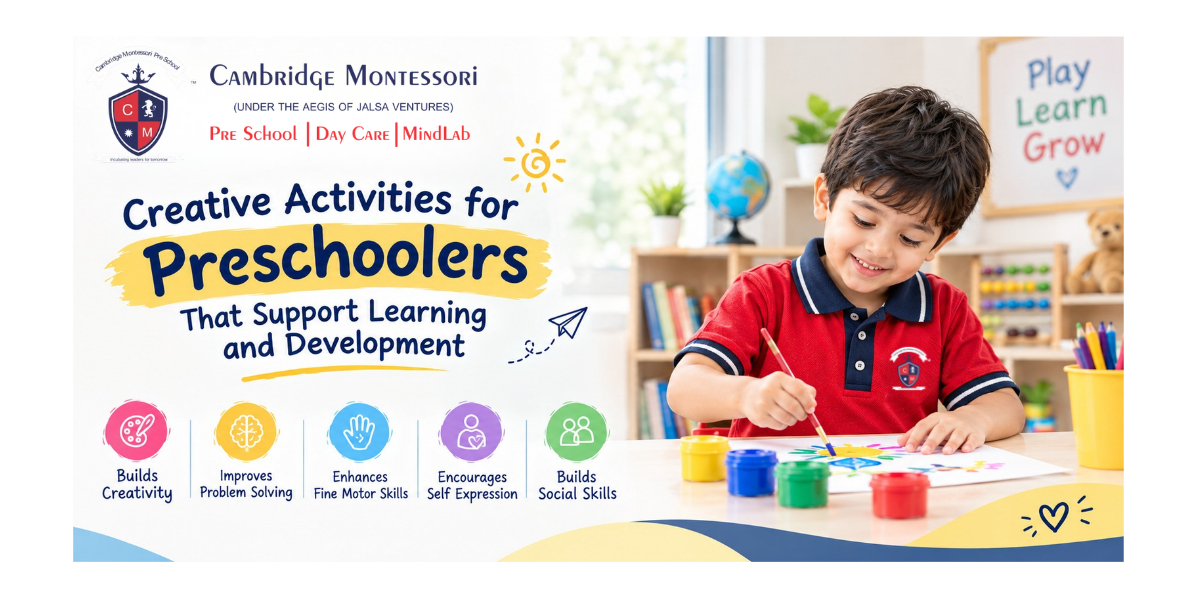
Creative Activities for Preschoolers That Support Learning and Development
Introduction
Preschool-aged children are generally curious, energetic, and eager to explore the world around them. Creative Activities for Preschoolers That Support Learning and Development can help children build a range of useful skills, including cognitive, social, emotional, language, and motor skills. The best activities do not need to be complex and can involve simple materials such as crayons, paper, blocks, clay, and household items. More important than the materials is creating an environment where children feel encouraged to explore, experiment, and enjoy creative activities as part of their learning.
1. Drawing and Colouring
Drawing is among the first activities that young children learn. Give children access to crayons, coloured pencils, paints and chalk and encourage them to make simple drawings of objects, shapes or people. Drawing promotes fine motor skills, and hand-eye coordination, while also letting children experiment. Question them on their drawings to encourage them to verbalize and describe their ideas. Instead of seeking to create a “perfect” picture, children should be encouraged to think creativity while drawing.
2. Playdough and Clay Activities
Playdough is one of the best hands-on activities for young children, which encourages creative thinking and strengthens fine motor skills. As children roll, squeeze, flatten, cut and shape materials, they also develop their imagination and mathematical concepts. Children can create simple patterns and different objects using playdough.
3. Building Blocks
Playing with building blocks encourages children to turn into little engineers and architects as they build houses, towers and objects from their imagination. Building with blocks offers several advantages to children such as building spatial awareness, creativity and planning. As they learn about balance, size and shapes, they build early engineering skills.
4. Storytelling and Puppet Making
Story-telling is an activity which gives wings to a child’s imagination. Children can develop simple puppets out of materials such as paper, cardboard or bags, and enact a puppet story once the puppets are ready. This is an intellectually rich activity that also develops memory, communication skills and children’s expressiveness. Parents and teachers can complement the child’s activity by asking questions related to the play.
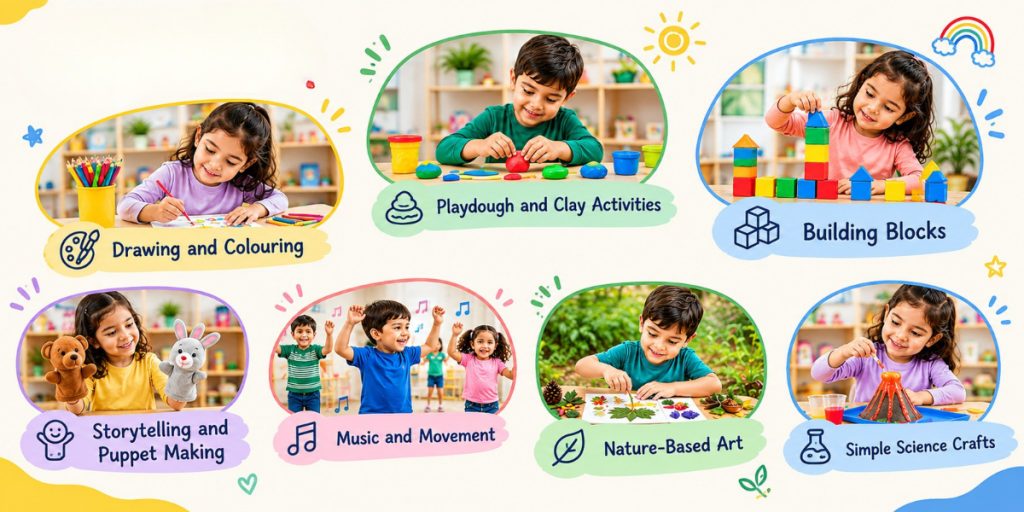
5. Music and Movement
Music is an excellent way for preschoolers to develop their cognitive skills. It is not important for students to learn complicated musical notes but learning simple songs and rhythms is sufficient. Children can also make instruments from household materials. Musical activities strengthen children’s listening skills, memory and coordination, and also develop early mathematical concepts through counting beats and playing out patterns.
6. Nature-Based Art
Children can collect various natural objects such as pebbles, leaves and flowers and turn them into artistic pieces. They can paint these according to their imagination and create collages or pictures using them. Using natural, backyard objects encourages them to recycle products and utilize them in art. They also learn more about the environment.
7. Simple Science Crafts
Basic science can also be introduced into play, through activities like making a colour-mixing experiment or lighting a bulb made at home. These activities encourage students to think scientifically, observe results and explain their discoveries.
Making Creativity Part of Everyday Learning
Creative activities can be integrated into children’s daily routines and a supportive preschool environment. Children should be encouraged to persevere despite failures and mistakes. These activities provide several benefits, including developing mathematical abilities, imagination, problem-solving, and self-expression, and can easily become a meaningful part of preschool education.
READ MORE :Language Development Activities for Preschoolers: Simple Ideas for Home
FAQ’s
Q1: What are the best creative activities for preschoolers?
Ans: The best creative activities for preschoolers include drawing, painting, story-telling, puppet making, music, nature art and playdough activities.
Q2: How do creative activities support preschool development?
Ans: Creative activities develop the language, problem-solving, imagination, communication and fine motor skills, among other benefits.
Q3: Do creative activities require expensive materials?
Ans: No, creative activities can be easily performed with home-based materials such a paper, cardboard, crayons, boxes, leaves and household objects.
Q4: How long should a preschool creative activity last?
Ans: Short, engaging sessions are preferred as they provide children with the required flexibility and effectiveness.
Q5: Should adults correct a child’s artwork?
Ans: Adults should avoid correcting or focusing on their child’s artwork. At such a young age, it is best to let the child create art independently, and without criticism.
Q6: Can creative activities be used in preschool classrooms?
Ans: Yes, preschool activities are a part of many preschool curriculums, including that of Cambridge Montessori preschool. The Montessori method of preschool encourages hands-on learning and creative activities.
Q7: Can creative activities improve problem-solving skills?
Ans: Yes, creative activities encourage children to experiment, make choices, find solutions, and think about different ways to complete a task.
Q8: How do creative activities support imagination?
Ans: Drawing, storytelling, pretend play, and craft activities give children opportunities to create their own ideas, stories, and experiences.
Q9: Can creative activities help develop fine motor skills?
Ans: Yes, activities such as colouring, drawing, cutting, clay modelling, and playdough help children practise hand and finger movements.
Q10: Can parents do creative activities with children at home?
Ans: Yes, parents can use simple household materials to introduce drawing, craft, storytelling, building, and other creative activities at home.