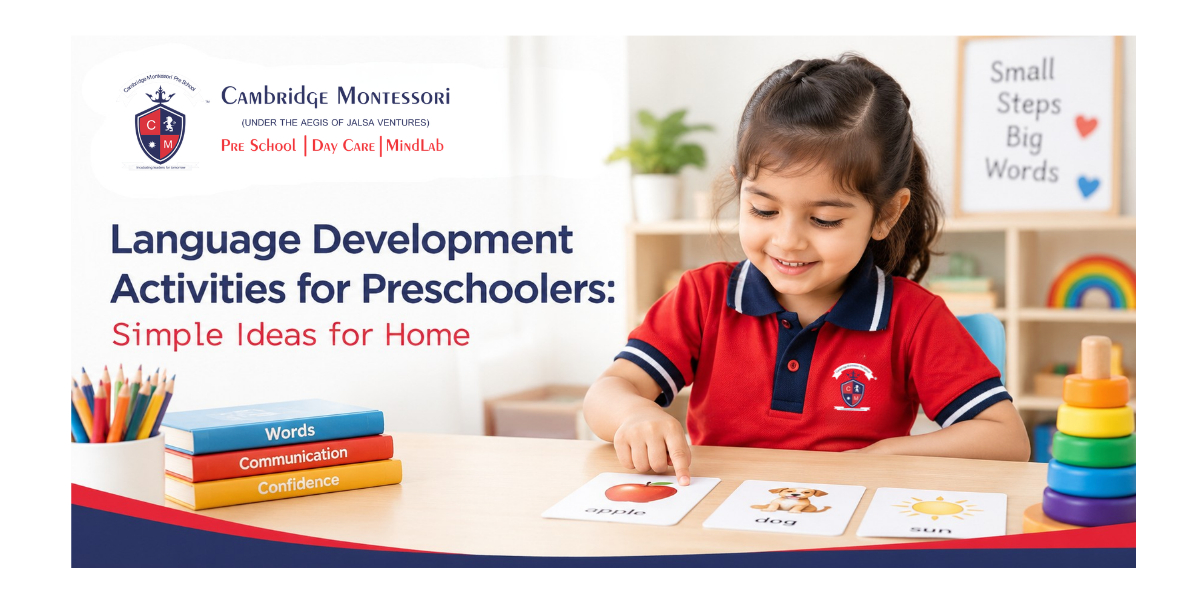
Language Development Activities for Preschoolers: Simple Ideas for Home
Language development for children grows through everyday experiences such as reading, cooking, dressing, travelling, and play. Language Development Activities for Preschoolers: Simple Ideas for Home can help parents turn these daily moments into meaningful learning opportunities. Children strengthen their communication skills when parents speak, listen, and respond to them. Back-and-forth conversations give children opportunities to use words with purpose rather than simply sharing information.
Read Interactively
While reading to your child, let your child play an active role by holding the book, predicting events, explaining pictures and retelling the story. Re-read stories that are your child’s favorites. Use book reading as an activity to introduce new words in the child’s vocabulary.
Use Songs, Stories and Pretend Play
Use songs and stories to practice vocabulary. Puppets and pretend play can create opportunities to question, answer, negotiate and describe. According to UNICEF, play is an important way to learn and develop as a person [1].
Expand Rather Than Test
If your child says bird fly, reply that a white bird is flying in the sky. Do not make every conversation about colours. Share your observations with your child and let him or her respond.
Support Multilingual Development
Most families use the language in which they are most comfortable. Mixing languages can be a normal part of multilingual development, both at home and in a preschool environment. Seek advice if the child finds it difficult to communicate across languages or consistently struggles to express their needs and ideas.
READ MORE : Screen Time for Preschoolers: How Parents Can Build a Healthy Daily Routine
FAQ’s
Q1: Do flashcards build language skills?
Ans: Flashcards can help children learn labels, but conversation, reading, and play support broader language development.
Q2: How often should we read with a child?
Ans: Reading every day gives children regular opportunities to hear new words, understand stories, and practise communication.
Q3: Can everyday activities support language development?
Ans: Yes. Cooking, dressing, travelling, and play provide natural opportunities to introduce words and encourage conversation.
Q4: Is talking with children important for language development?
Ans: Yes. Back-and-forth conversations help children understand how words are used to express ideas, needs, and feelings.
Q5: Is mixing languages normal for multilingual children?
Ans: Yes. Mixing languages can be a normal part of multilingual language development.
Q6: How can parents encourage children to speak more?
Ans: Ask open-ended questions, listen patiently, and respond to what the child says during everyday activities.
Q7: Should parents correct every language mistake?
Ans: No. Respond naturally and model the correct language instead of interrupting the child’s communication.
Q8: When should I seek professional help?
Ans: Consult a speech-language practitioner if the child has persistent difficulty understanding others, communicating, or experiences a loss of previously developed language skills.
References
Health note: This article provides general educational information and does not replace advice from a paediatrician or another qualified professional.