What Is Montessori Education? (And How It Differs From Traditional Preschool)
“What is Montessori Education” gets used so loosely these days that it’s almost lost its meaning. Some people think it’s a brand of wooden toy. Others think it’s a fancy daycare. So let’s answer the question simply and honestly — and then put it side by side with a traditional preschool so you can see the real difference.
The Short Answer
Montessori education is a child-centred approach developed by Dr. Maria Montessori. Instead of following one fixed lesson, children choose meaningful activities at their own pace. As a result, they develop independence, confidence, and problem-solving skills through hands-on learning experiences.
In simple terms, the big idea is almost radical in its simplicity: children are naturally driven to learn, and the adult’s job is to remove obstacles and guide—not to pour information into a passive child.
To understand why this approach works so well, it’s helpful to know where it began.
Maria Montessori did not begin with a theory. Instead, she carefully observed how children naturally learned. During her research, she discovered that children preferred purposeful activities over passive instruction. Consequently, she developed an educational approach that encouraged curiosity, independence, and self-directed learning.
She spent the rest of her life refining that observation into a method. Over a century later, it’s practiced in thousands of schools across the world — and, as we’ll see, its core ideas now echo through India’s own education policy.
The Five Things That Make a Classroom Truly Montessori
According to the American Montessori Society, a few core components define an authentic Montessori environment:
-
- A prepared environment — a room deliberately set up with child-sized furniture and orderly, accessible materials so children can act independently.
- Hands-on materials — concrete, often self-correcting tools (bead chains, sandpaper letters, sensorial blocks) that let a child feel a concept before abstracting it.
- Freedom within limits — children choose their own work, within clear and consistent ground rules.
- Mixed-age classrooms — typically spanning ages 2.5 to 6, so children learn from and teach one another.
- The teacher as guide — an adult who observes and introduces, rather than lectures.
these five principles work together to create a genuine Montessori learning environment. It may be lovely—but it isn’t really Montessori, whatever the signboard says.
You may also like: Montessori Education Guide: Everything Parents Need to Know
Montessori vs Traditional Preschool: An Honest Comparison
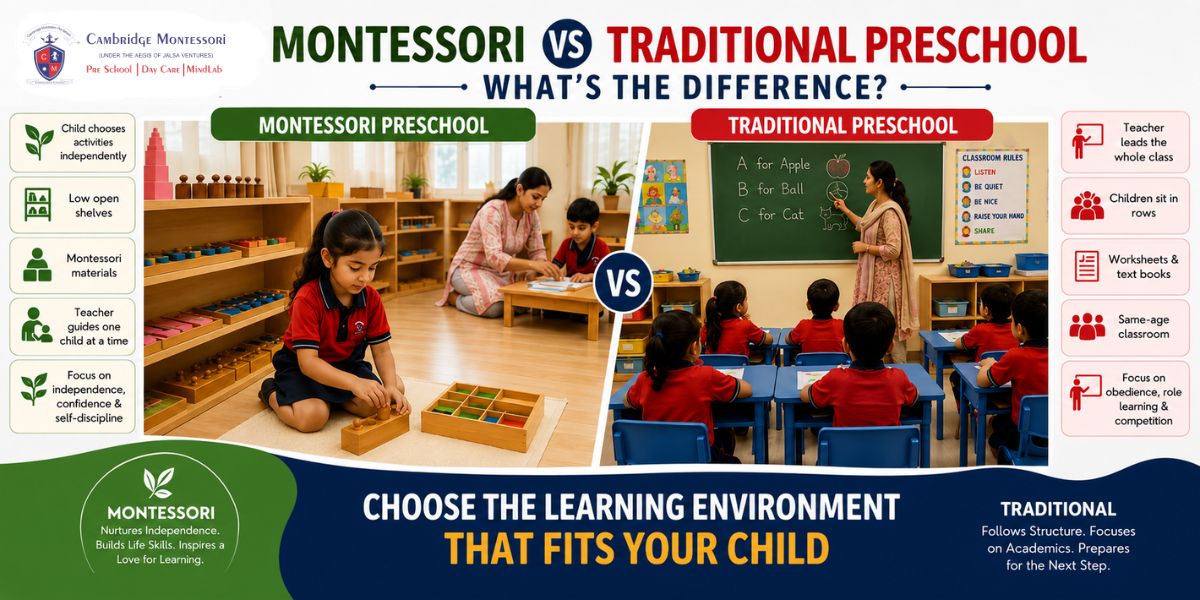
Both can be excellent. But they’re built on genuinely different assumptions about how children learn. Here’s how they tend to differ in practice:
Who leads the learning?
Traditional: The teacher sets the lesson; the whole class follows the same activity at the same time.
Montessori: The child chooses their work from a range they’ve been shown, moving at their own pace.
What does the room look like?
Traditional: Desks or tables facing a teacher, often with a clear “front” of the class.
Montessori: Open shelves, floor mats, and work stations; children move freely around a prepared space.
How is the day structured?
Traditional: Broken into short, timetabled slots — circle time, then craft, then snack.
Montessori: Long, uninterrupted work periods that protect deep concentration.
How are ages grouped?
Traditional: Single-year batches (all the four-year-olds together).
Montessori: Mixed ages in one room — a deliberate design we explain in Why Mixed-Age Classrooms Work.
How is progress measured?
Traditional: Often through marks, stars, and comparison between children.
Montessori: Through the teacher’s observation and the child’s own visible mastery, with self-correcting materials doing much of the feedback.
What’s the ultimate goal?
Traditional: School readiness, often defined as knowing letters, numbers, and routines.
Montessori: That too — plus independence, concentration, and intrinsic motivation as the foundation.
Overall, the honest takeaway is that traditional preschool tends to optimise for conformity and coverage, while Montessori focuses on independence, curiosity, and deeper learning experiences.
Read More: Montessori Education: Everything Parents Need to Know
But Does the Difference Actually Matter?
In fact, the difference is supported by research—not just educational philosophy.. In October 2025, the Proceedings of the National Academy of Sciences published the largest randomized trial of Montessori preschool to date. Following 588 children, it found that those who attended Montessori had significantly better reading, executive function, memory, and social understanding by the end of kindergarten — at lower cost per child. We unpack these findings in full in The Benefits of Montessori Learning.
The India Connection
Indian parents have an extra reason to take Montessori seriously right now. India’s National Education Policy 2020 reorganised early schooling around a Foundational Stage for ages 3 to 8 that explicitly champions play-based, activity-based, and experiential learning. That’s essentially a national endorsement of the very principles Montessori has practiced for over a century—making this Montessori approach feel less like an import and more like a natural fit for where Indian education is heading.
So, Is It Right for Your Child?
If your child is curious, likes to do things with their hands, and thrives when trusted with a bit of independence, a genuine Montessori environment can be transformative. If you prefer a more directed, structured-from-the-front approach, traditional preschool may suit you better.
The best advice we can give: visit both. Watch the children, not the brochures. A real Montessori room reveals itself instantly — calm, purposeful little people, busy with work they chose themselves.
If you’d like to see one, book a visit to a Cambridge Montessori Global center near you and judge for yourself.
Frequently Asked Questions
1. What is the ideal age to start Montessori education?
Most Montessori schools welcome children between 1.5 and 3 years of age, although some offer toddler programs starting at 18 months. Beginning early allows children to develop independence, communication skills, and confidence during their most important years of growth.
2. Is Montessori education suitable for every child?
Yes. Montessori education is designed to support children with different learning styles, personalities, and abilities. The child-centred approach allows each learner to progress at their own pace while receiving guidance from trained educators.
3. How does Montessori education prepare children for primary school?
Montessori education helps children develop school readiness by strengthening language, mathematics, problem-solving, concentration, social skills, and independence. These foundational skills make the transition to primary school smoother and more confident.
4. Do Montessori children learn reading and writing later than traditional preschool students?
No. Montessori children are introduced to language through hands-on materials that build phonics, vocabulary, and writing skills naturally. Many children develop strong literacy skills because they first understand concepts through practical experiences before moving to abstract learning.
5. Why are mixed-age classrooms important in Montessori education?
Mixed-age classrooms encourage collaboration, leadership, and peer learning. Younger children learn by observing older classmates, while older children strengthen their knowledge by helping younger learners, creating a supportive learning community.
6. Is Montessori education recognized in India?
Yes. Montessori education is widely recognized across India and aligns closely with the principles of the National Education Policy (NEP) 2020, which promotes play-based, activity-based, and experiential learning during early childhood education.
7. What should parents look for when choosing a genuine Montessori preschool?
Parents should look for trained Montessori educators, child-sized learning environments, authentic Montessori materials, mixed-age classrooms, and opportunities for self-directed learning. Visiting the school and observing classroom interactions can help determine whether the Montessori approach is implemented authentically.
8. What are the long-term benefits of Montessori education for children?
Montessori education supports lifelong skills such as independence, critical thinking, creativity, self-discipline, confidence, communication, and problem-solving. These qualities help children become adaptable learners and responsible individuals throughout their academic and personal lives.