Montessori Preschool Education
Selecting the most suitable Montessori Preschool Education program for your child is one of the most important decisions a parent can make. The first few years of a child’s life are crucial because children learn quickly, develop essential skills, and build habits that shape their future. The Montessori Preschool Education approach, developed by Dr. Maria Montessori, is based on the belief that every child is naturally curious and capable of learning through exploration. Unlike traditional teaching methods, the Montessori Method does not rely on rote learning or expect every child to learn at the same pace. Instead, it encourages hands-on experiences, independent thinking, and personalized learning in a nurturing environment that supports every child’s unique developmental journey.
Cambridge Montessori believes in providing each child with a safe and respectful environment for learning and growing. Our Montessori classes are specially designed for fostering confidence and creativity in children.
What is Montessori Preschool Education
Montessori Preschool Education is not only a teaching approach but also a philosophy promoting healthy child development. The approach recognizes that all children learn in different ways and need to be able to develop naturally.
In contrast to regular school environments where children have to follow one program, Montessori school education provides an opportunity for a child to engage in various activities that suit his or her interests and developmental level. Such an approach fosters a positive learning experience because a child has fun with the discovery process.
The primary objective of Montessori education is the development of a competent and independent person who will be responsible and successful both academically and in life
Two Basic Principles of Montessori Approach
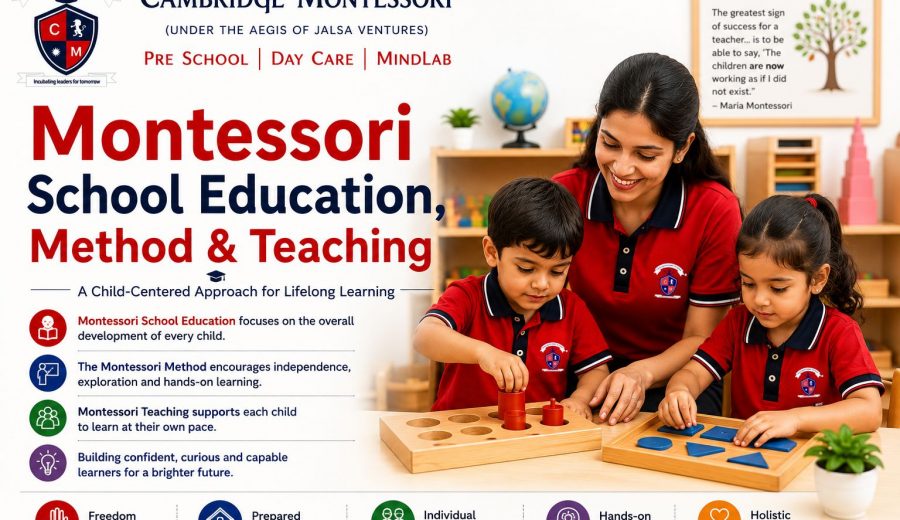
Montessori approach is characterized by two basic principles which ensure proper development of the child.Freedom Within the Boundaries.The first one is the freedom of choice which children have while doing something in Montessori school
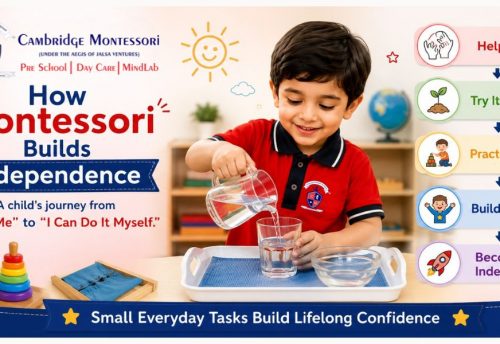
Nevertheless, freedom is always associated with some limitations and requirements. Children are allowed to choose what activity they will perform based on their preferences but they should learn responsibility, respect and discipline at the same time.For example, children can select whatever material they want, however, they must complete working with it and return it back to the place it should be.
Thus, freedom combined with discipline promotes independence and helps children learn about the necessity of following the rules and being respectful towards other people. Arrangement of Montessori Classroom The second principle is related to the arrangement of the Montessori classroom since it is specifically designed for studying and exploring. All learning materials are selected for a specific purpose and placed in such way that children could access them easily. Classroom is clean, comfortable and provides children the possibility to move freely and study independently. Instead of reading books, children can use various learning materials in Montessori classroom.
How Children Learn in Montessori Preschools
Children tend to be naturally curious about the environment surrounding them. By recognizing this natural curiosity, the Montessori philosophy incorporates it into the teaching system to have children learn through doing rather than memorizing. Instead of giving answers to children, they are taught to ask questions, test ideas, observe and find the solution by themselves. Children gain deeper understanding and retain knowledge longer in this way. At the same time, children develop their problem solving skills, logic and creativity
Every Child Learns Differently
One of the main advantages of Montessori Preschool Education is an understanding of the uniqueness of every kid.Some kids learn fast, while others require additional time for mastering a certain skill.Instead of comparing one child with others, Montessori teachers pay attention to individual development of each kid.Each new task can be taken up by kids only after they master the previous one.This method of teaching makes kids feel confident and avoids excessive pressure.Respect for Every KidRespect is one of the major aspects of the Montessori education system.Children are considered to be individuals who think, have their interests and abilities.Teachers carefully listen to them, answer all questions and help them instead of controlling all activities.
The Importance Of The First Six Years
According to the Montessori approach, the first six years of a child’s development are considered the most important regarding education and learning.During this time, the brain of the child becomes highly receptive to all that it hears, sees, and does.Therefore, it is the best time for introducing the child to such things as language, mathematics, life, imagination, and sociability.That is why there are numerous activities in Montessori classrooms
Activities With Purpose Develop Good Skills
- Kids like being busy as long as there is a meaning to the activity.
- In Montessori education, everything that the kids do has a purpose.
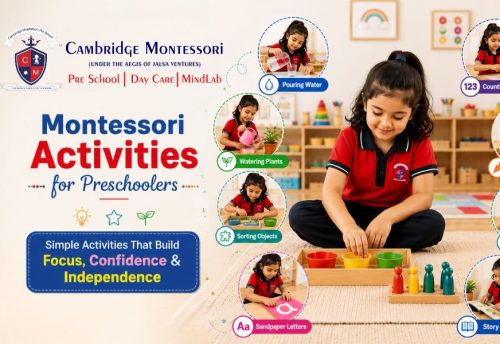
- From organizing blocks, pouring water, matching shapes to learning letters, all these activities are meant to develop various skills such as concentration, coordination, patience, and independence.
- The children are not busy just to complete an activity.
- Rather, they like the process of learning itself.
The Montessori Teacher’s Role
Montessori educators are not just teachers that impart knowledge to children through lectures in the classroom
Act as They guides.
They observe all the children in order to know their likes and dislikes as well as what they find hard or easy.Depending on their observations, they present new learning materials and activities.Through such guidance, the children learn with confidence with the teacher there for support.
Advantages of Montessori Preschool Education
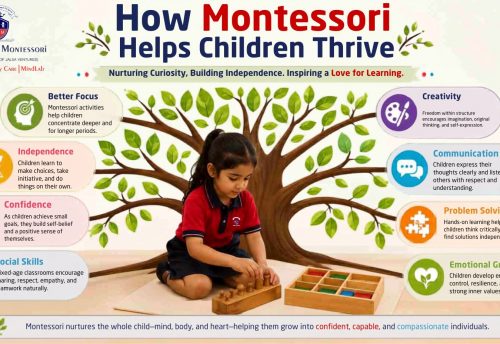
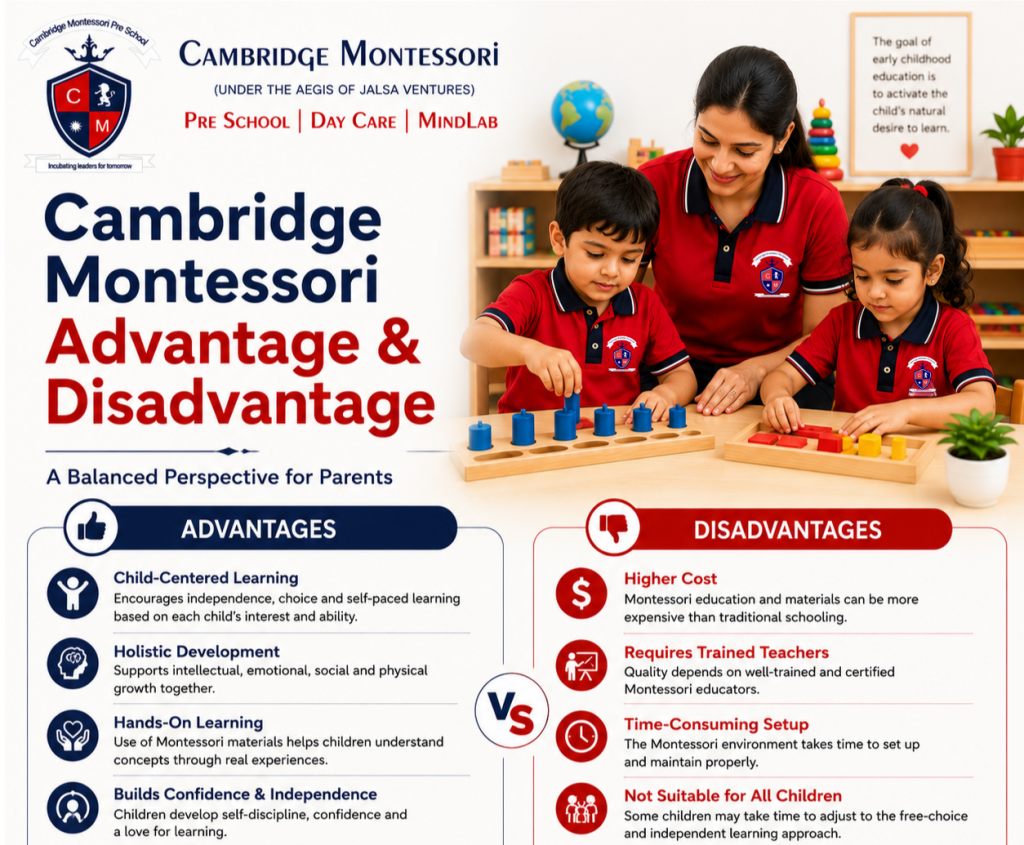
The reason parents opt for Montessori education is that it promotes all round development of the child
Some of the advantages are
- Fosters independent learning
- Fosters creativity and imagination
- Improves problem solving skills
- Fosters responsibility and discipline
- Hands on experience
- Respect for each child’s own pace of learning
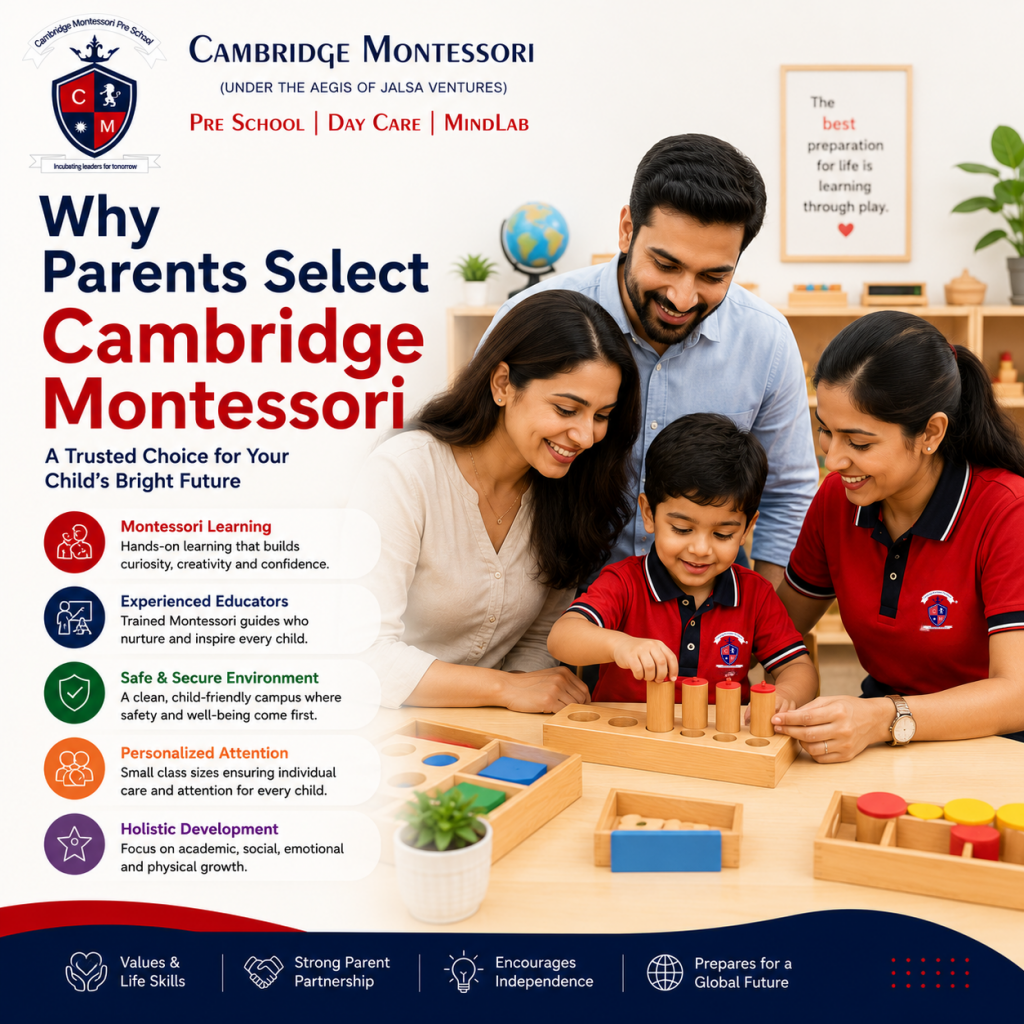
Why Parents Select Cambridge Montessori
Cambridge Montessori guarantees you the genuine Montessori experience as well as a positive and safe learning environment for each child enrolled in our school. The professional staff at Cambridge Montessori will teach your kids with care, patience, and encouragement. We feel that the process of learning should be enjoyable, effective, and individual to each kid. We employ authentic Montessori teaching materials and specially designed environments where the Montessori children get an opportunity to learn and grow daily. Our program includes not only academics but communications, creativity, emotions, and socialization as well.
Conclusion
The Montessori Preschool Education is not only a way to teach but a system based on the natural growth of children through discovery, independence, and significant experience. The Montessori Method of Teaching promotes self-respect, interest in the surroundings, and skills through recognizing individuality and encouraging the child to learn according to his/her own pace. At Cambridge Montessori, we offer an environment that encourages the development of the unique talents of each individual child. No matter whether you are looking for a preschool or just get familiar with early childhood education, the Montessori philosophy is a good starting point for the further development of your Child.
FAQs: (Frequently Asked Questions)
1. What is Montessori education?
Montessori education is a child-centered learning method that promotes independence and hands-on learning.
2. What is the Montessori teaching method?
It is a teaching approach where children learn through practical activities at their own pace.
3. What age is best for Montessori?
Most children start Montessori between 2.5 and 3 years of age.
4. How is Montessori different from traditional schools?
Montessori focuses on self-directed learning instead of teacher-led instruction.
5. What are the benefits of Montessori education?
It builds confidence, creativity, independence, and problem-solving skills.
6. What subjects are taught in Montessori schools?
Language, math, science, practical life skills, art, and cultural studies.
7. Are Montessori teachers specially trained?
Yes, Montessori teachers receive certified training in the Montessori method.
8. Is Montessori education good for every child?
Yes, it supports different learning styles and encourages holistic development.
9. Do Montessori schools give homework?
Homework is usually minimal, especially in the early years, to encourage experiential learning.
10. Why should parents choose Montessori education?
It helps children become confident, independent, and lifelong learners.