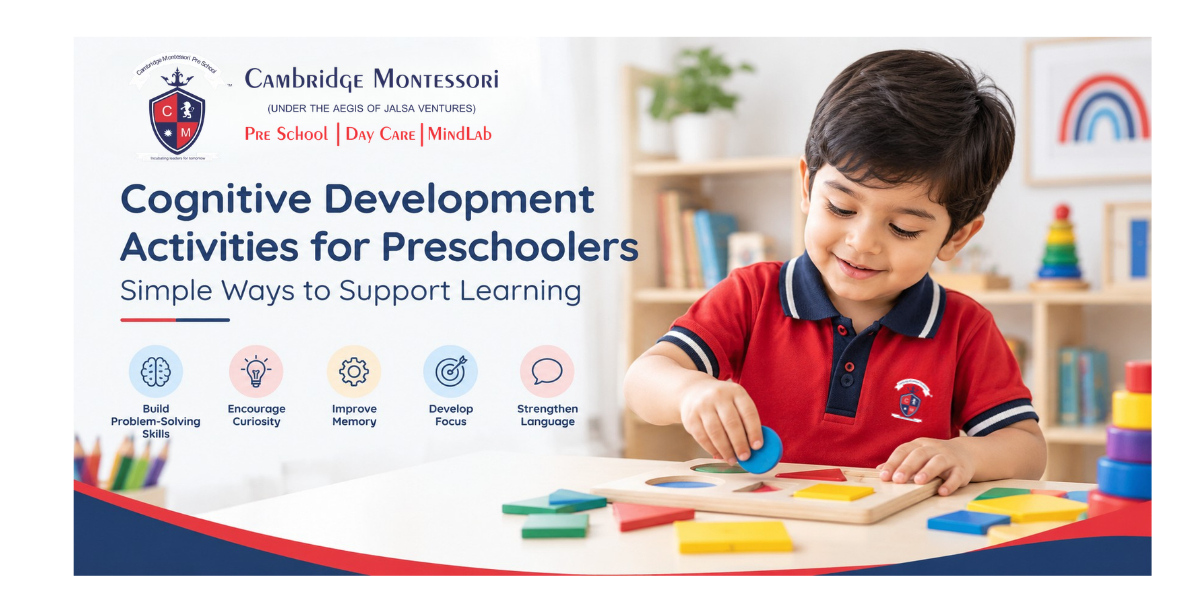
Cognitive Development Activities for Preschoolers Simple Ways to Support Learning
Cognitive activities are extremely important in early childhood. Cognitive Development Activities for Preschoolers Simple Ways to Support Learning can help children develop their mental capabilities by encouraging them to remember, compare, predict, classify, plan and solve problems. The best activities do not feel heavy or complicated and can be easily introduced by parents using inexpensive materials, household objects, everyday conversations and outdoor observation.
Sorting, Matching and Patterns
Sorting activities build cognitive reserve. Objects such as buttons, leaves and books can be sorted by colours, use and shapes. Patterns with beads and blocks can be created by the child. These actions also improve the child’s sequencing and memorizing skills.
Memory and Sequencing Games
Games such as matching cards, hiding an object under cups, retelling the steps of a recipe or arranging picture cards into a story practice executive function. These activities are challenging enough for the child to require effort, but not so difficult that the child completely disengages [1].
Early Maths and Science Activities
Activities that are directly based on science build the foundation for a child’s academic skills. In a preschool environment, these can include counting stairs, comparing container capacity, testing objects that float, building ramps and predicting which car travels farther. The child should also be encouraged to investigate these everyday occurrences scientifically and suggest what might happen next.
READ MORE :Social Skills in Preschoolers: Helping Children Share, Communicate and Make Friends
FAQ’s
Q1: Do cognitive activities require worksheets for the child to use?
Ans: No, worksheets are not required. Hands-on play, observation, exploration and conversation can effectively support cognitive development.
Q2: What should be the duration of a cognitive activity?
Ans: The activity should continue as long as the child remains interested and engaged. It can be stopped when the child shows signs of frustration or loses interest.
Q3: Should every answer given by a child be corrected?
Ans: No. Instead, ask the child how they arrived at the answer and encourage them to test their idea or explore another way to solve the problem.
Q4: Can everyday household objects be used for cognitive activities?
Ans: Yes. Items such as cups, spoons, boxes, blocks and containers can be used for sorting, counting, comparing and problem-solving activities.
Q5: How can parents encourage problem-solving skills at home?
Ans: Parents can ask open-ended questions, provide simple challenges and give children time to think, experiment and find solutions independently.
Q6: Are outdoor activities useful for cognitive development?
Ans: Yes. Outdoor observation can encourage children to notice patterns, compare objects, make predictions and ask questions about their surroundings.
Q7: How can science activities support preschool learning?
Ans: Simple activities such as testing floating objects, building ramps or comparing container capacities encourage children to observe, predict, test and understand cause and effect.
Q8: What should parents do when a child struggles with an activity?
Ans: Parents can offer small hints or ask guiding questions without immediately providing the answer. This allows the child to keep thinking and develop confidence in solving problems.
References
Health note: This article provides general educational information and does not replace advice from a paediatrician or another qualified professional.