Best Play School in Delhi: Parent’s Selection Guide
Choosing the Best Play School in Delhi involves more than comparing attractive classrooms, popular school names or convenient locations. Parents need to understand how a preschool supports early learning, builds confidence, encourages independence and keeps children safe. The right choice should suit a child’s developmental needs while giving parents confidence in the school’s teachers, daily routine and educational approach.
Before selecting a school, parents should compare teaching methods, classroom experiences, safety standards, teacher quality and communication with families. Whether you are looking for a play school near your home or comparing preschool and daycare options, the priority should be finding a setting that supports your child’s development and fits your family’s daily routine.
This guide explains the key factors to consider when shortlisting schools and choosing a suitable early learning environment for your child.
How to Choose the Best Play School in Delhi for Your Child
The best preschool for one child may not necessarily be the best fit for another. Some children respond well to hands-on exploration and independent activities, while others benefit from more guided group experiences. Parents should therefore begin by understanding the school’s teaching philosophy and how it is reflected in everyday learning.
During a school visit, ask how children spend a typical morning. Do they have opportunities to explore learning materials, listen to stories, participate in creative activities and interact with their classmates? Are activities appropriate for their age, and can teachers adapt them to different developmental needs?
When comparing play schools in Delhi, consider:
- The educational philosophy and daily teaching practices.
- The experience and preparation of teachers.
- Opportunities for play, movement and social interaction.
- Classroom safety, hygiene and supervision.
- Communication between teachers and parents.
- Timings, fees and suitability for your family’s routine.
Rather than relying on a school’s reputation alone, observe a regular classroom session wherever possible. What you see can help you understand whether the school’s approach matches your expectations.
Montessori or Play-Based Learning: Which Approach Should Parents Consider?
Educational approaches are an important consideration when comparing preschools in Delhi. Montessori education, play-based learning and more teacher-directed programmes can all provide early learning experiences, but they may organise classroom activities differently.
A Montessori classroom typically uses specially designed learning materials, purposeful activities and opportunities for children to work at their own pace. Educators guide children while encouraging independence, concentration and practical life skills.
Play-based programmes may use pretend play, storytelling, building activities, music and collaborative experiences to help children explore ideas and develop social skills. Some preschools combine elements of different approaches.
When comparing these options, look beyond the name of the method. Ask how teachers introduce new concepts, support children who need additional help and observe individual progress. The quality of implementation matters more than a label on a brochure.
Parents should also consider whether the daily routine gives children enough opportunities to ask questions, practise new skills, move around and learn through meaningful experiences.
Teacher Quality Matters More Than Attractive Classrooms
A well-designed classroom can support learning, but teachers determine how children experience it every day. Young learners need educators who can guide them patiently, recognise their emotions and create opportunities for participation.
When visiting a play school in Delhi, notice how teachers speak to children. Do they listen carefully? Do they encourage children to try tasks independently? How do they respond when a child becomes upset, loses interest or finds an activity difficult?
Ask the school about teacher qualifications, early childhood education training, experience with the relevant age group and ongoing professional development. You should also understand how the school manages supervision when children move between activities or use shared spaces.
Parent communication is equally important. Find out whether teachers provide meaningful updates about learning, social interaction, participation and adjustment. A clear communication process helps families understand their child’s experience and raise concerns when necessary.
A strong preschool is not defined only by its infrastructure. It is also defined by the quality of relationships children develop with the adults who guide them.
Safety, Hygiene and Supervision: What Should Parents Check?
Safety should be a non-negotiable factor when selecting a preschool. Parents should understand how a school prevents avoidable risks, supervises children and responds when something unexpected happens.
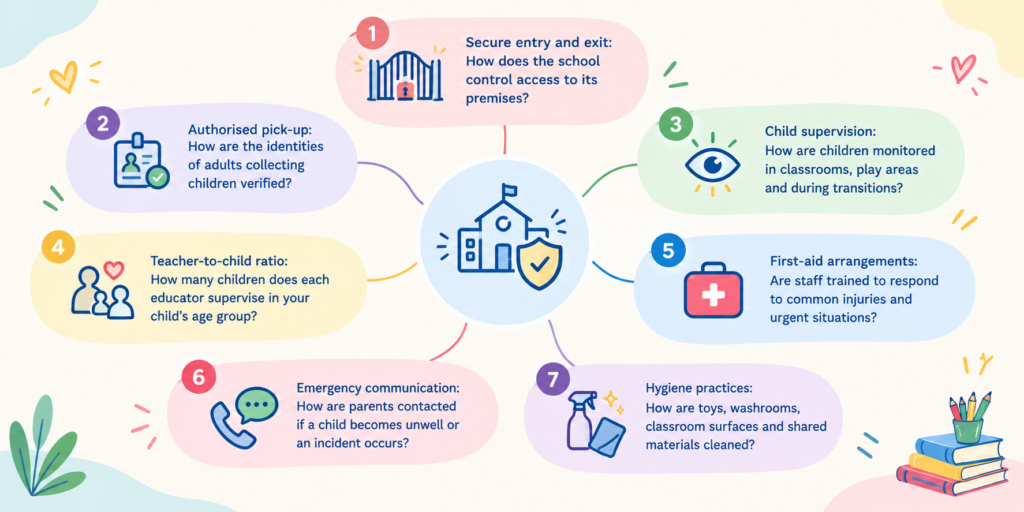
Before enrolling your child, ask about these essential areas:
-
Secure entry and exit: How does the school control access to its premises?
-
Authorised pick-up: How are the identities of adults collecting children verified?
-
Child supervision: How are children monitored in classrooms, play areas and during transitions?
-
Teacher-to-child ratio: How many children does each educator supervise in your child’s age group?
-
First-aid arrangements: Are staff trained to respond to common injuries and urgent situations?
-
Emergency communication: How are parents contacted if a child becomes unwell or an incident occurs?
-
Hygiene practices: How are toys, washrooms, classroom surfaces and shared materials cleaned?
These checks are important whether you are comparing a preschool or searching for the best daycare in Delhi for your family’s childcare needs.
Do not assume that a school follows a particular safety practice simply because it advertises itself as child-friendly. Ask for specific explanations and check what you can observe during your visit.
A responsible school should be transparent about its procedures and explain how they are implemented throughout the day.
What Should a Good Preschool Daily Routine Include?
A balanced daily routine helps children become familiar with their surroundings while providing a variety of learning experiences. When comparing the best play schools in Delhi, ask how the school balances guided activities with opportunities for free exploration.
An age-appropriate routine may include storytelling, conversations, music, creative activities, movement, outdoor play, practical tasks and time for children to interact with one another. Early literacy and numeracy can also be introduced through meaningful, developmentally appropriate activities.
Parents should understand how the school supports different aspects of development:
-
Language: Listening, speaking, vocabulary and early communication.
-
Social skills: Sharing space, cooperating and interacting with others.
-
Emotional development: Expressing feelings and gradually building confidence.
-
Physical development: Movement, coordination and age-appropriate activities.
-
Thinking skills: Exploring, observing, solving simple problems and making choices.
-
Independence: Practising everyday tasks with appropriate guidance.
Ask how educators notice a child’s progress and respond when additional support may be needed. A quality programme should focus on the whole child, rather than treating early education as preparation for worksheets or formal examinations alone.
Preschool and Daycare in Delhi: What Should Parents Compare?
Preschool and daycare serve related but different needs. A preschool generally focuses on early learning and development, while daycare provides care and supervision for longer periods. Some institutions offer both, making it important to understand exactly what each programme includes.
Parents comparing preschool and daycare in Delhi should review the daily schedule, staff availability, meals, rest periods, hygiene arrangements and afternoon activities. Do not assume that a school’s morning learning programme and extended-care provision offer the same experience.
If your family requires longer childcare hours, ask:
-
What are the available daycare timings?
-
How are children supervised during meals, rest and free play?
-
Are meals provided, and how are dietary requirements handled?
-
How does the school communicate with parents during the day?
-
Are the additional fees and services clearly explained?
When researching the best daycare in Delhi, assess the quality of care and supervision alongside convenience. A suitable arrangement should support children’s well-being while fitting your family’s practical requirements.
Preschool Fees, Timings and Location: Compare the Practical Details
A school may appear suitable academically, but parents also need to consider whether it works for their family’s daily routine and budget. When searching for a play school near me in Delhi, compare actual travel time, school hours and the services included in the fees.
Before making a shortlist, check:
-
Admission and registration charges.
-
Tuition fees and payment schedules.
-
Costs for meals, transport, activities or learning materials, where applicable.
-
School timings and holiday schedules.
-
Availability of extended care or daycare, if required.
-
Travel time during regular drop-off and pick-up hours.
-
The process for contacting teachers or school administration.
Do not compare schools on fees alone. Understand what each programme includes and whether the arrangements suit your child’s needs.
If you require daycare in addition to preschool, evaluate the extended-care programme separately. Ask about afternoon supervision, rest periods, meals, hygiene, staffing and activities. A school’s morning programme may differ significantly from its arrangements later in the day.
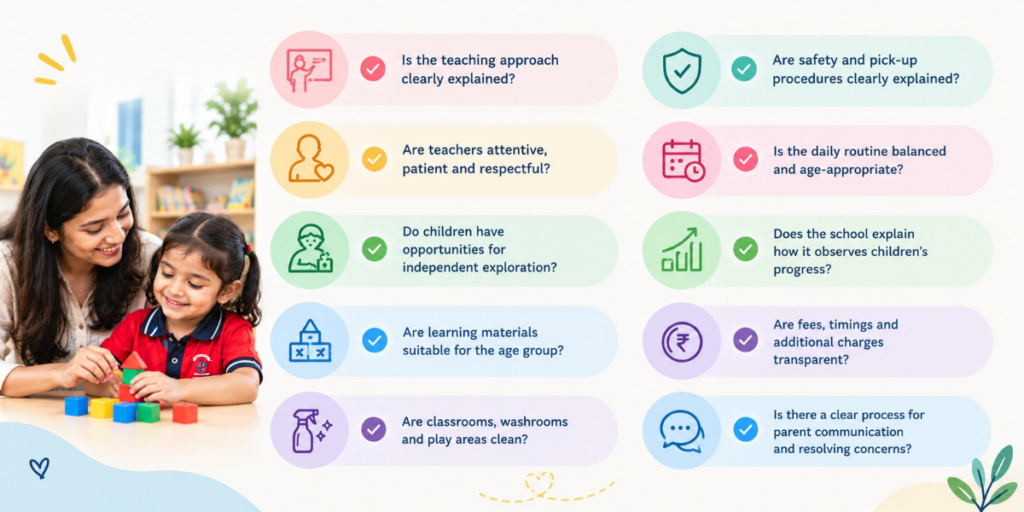
A Parent’s Checklist for Comparing Play Schools in Delhi
Once you have shortlisted a few schools, use the same checklist for each visit. This makes it easier to compare what they actually offer instead of relying on memory or first impressions.
- Is the teaching approach clearly explained?
- Are teachers attentive, patient and respectful?
- Do children have opportunities for independent exploration?
- Are learning materials suitable for the age group?
- Are classrooms, washrooms and play areas clean?
- Are safety and pick-up procedures clearly explained?
- Is the daily routine balanced and age-appropriate?
- Does the school explain how it observes children’s progress?
- Are fees, timings and additional charges transparent?
- Is there a clear process for parent communication and resolving concerns?
If possible, visit during regular school hours and ask questions about situations that matter to your family. For example: ask how a teacher supports a child who is hesitant to join group activities or how the school helps a new student settle into the routine.
The aim is not to find a school that promises everything. It is to identify one that can clearly explain its practices and demonstrate how it supports children’s everyday needs.
Understanding Cambridge Montessori and Its Educational Approach
Parents considering Cambridge Montessori can evaluate its approach alongside other preschool options by asking how Montessori principles are reflected in daily classroom practice.
Useful questions include how children use learning materials how educators encourage independence how activities are adapted to different developmental stages and how the classroom environment supports learning and exploration. You can also ask about teacher preparation, classroom routines, and the balance between individual work and group interaction, as well as how progress is communicated to parents.
The presence of the word “Montessori” alone does not establish the quality of a programme. Parents should assess the actual teaching practices, educator training and learning experience offered at the specific centre they are considering.
Before shortlisting any school, check its location, current programme details, timings and availability directly with the institution. This is especially important when comparing schools across different parts of Delhi, where the nearest suitable option may depend on your daily travel and family requirements.
The Bottom Line
Finding the right play school is about more than choosing a recognised name. Parents should look for a programme that combines attentive educators, safe facilities, meaningful learning experiences and a daily routine that respects children’s developmental needs.
When comparing the best play schools in Delhi, visit shortlisted schools, ask practical questions and evaluate their answers carefully. Consider teaching quality, child safety, communication, fees and convenience together rather than allowing one attractive feature to determine the decision.
A thoughtful choice can help your child begin their educational journey in a setting where they feel secure, supported and ready to explore the world around them.
Frequently Asked Questions ( FAQ’s )
Q1. How do I find the best play school in Delhi for my child?
Ans: Start by comparing teaching methods, teacher experience, safety procedures, daily routines, fees and parent communication. Visit shortlisted schools during regular hours and assess how teachers interact with children before making your decision.
Q2. What is the right age for a child to start play school?
Ans: Many children begin preschool between approximately two and three years of age, depending on the programme and their readiness. Check the school’s minimum-age requirements and consider your child’s comfort with separation, communication and daily routines.
Q3. What is the difference between a play school and a preschool?
Ans: The terms are often used interchangeably in India. Both may provide early learning and social experiences before formal schooling, but the specific curriculum, teaching approach and daily routine vary by institution. Review the actual programme rather than relying on its name.
Q4. Is Montessori education a good option for preschool children?
Ans: Montessori education can suit children who benefit from hands-on learning, purposeful activities and opportunities to practise independence. Parents should assess the educator’s training, classroom materials and how the approach is implemented at the individual school.
Q5. What should I check during a preschool visit?
Ans: Observe teacher-child interactions, classroom organisation, learning materials, hygiene, supervision and opportunities for play. Ask about the daily schedule, safety procedures, parent communication and how the school supports children who need extra help settling in.
Q6. How important is the teacher-to-child ratio?
Ans: It is an important factor because teachers need sufficient time to supervise children and respond to individual needs. Ask the school about the ratio for your child’s age group and how staff coverage is maintained during activities and transitions.
Q7. How can I compare preschool fees in Delhi?
Ans: Request a clear breakdown of tuition, registration, meals, transport, materials and any additional charges. Compare the services included in the total cost, along with timings, teaching practices and safety arrangements.
Q8. What should I look for when choosing the best daycare in Delhi?
Ans: Evaluate supervision, staff availability, hygiene, meal arrangements, rest periods, safety procedures and parent communication. Visit during the hours your child would attend and confirm the timings, services and fees directly with the provider.
Q9. When should parents start the preschool admission process?
Ans: Start researching several months before your preferred joining date if possible. Each school sets its own application schedule, eligibility rules and document requirements, so confirm the latest details directly with the institution.
Q10. How can I tell whether a preschool is suitable for my child?
Ans: Look for a setting where your child can gradually become comfortable, explore activities, interact with teachers and receive appropriate support. Consider your observations alongside the school’s teaching approach, safety practices and willingness to communicate with parents.