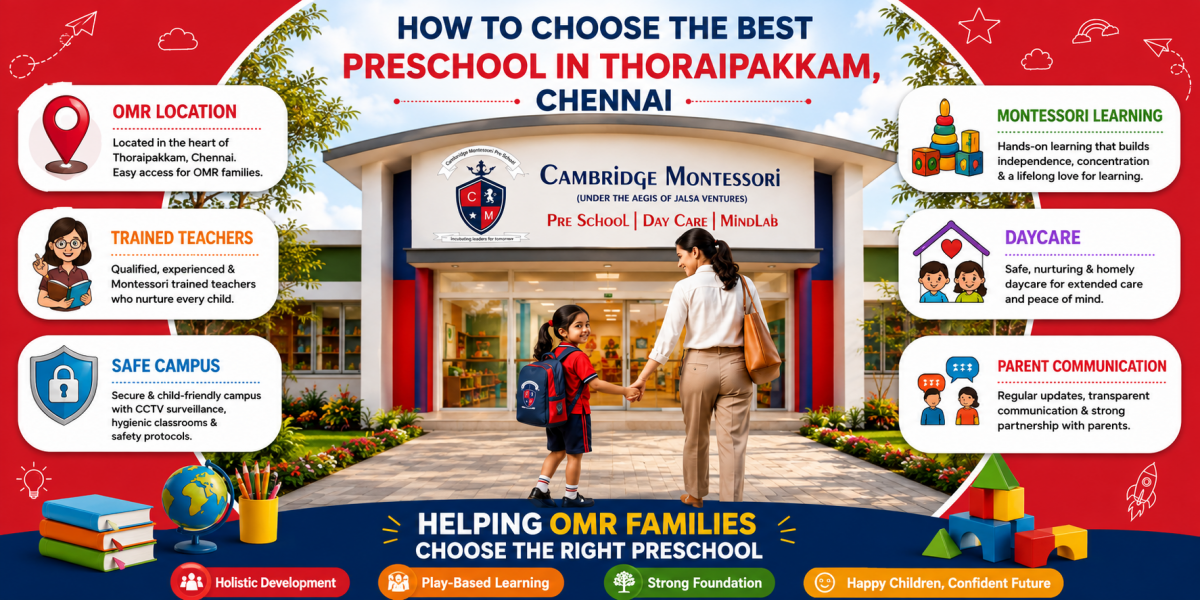
Are you searching for how to choose best preschool in Thoraipakkam? With so many options along the OMR corridor, choosing the right early learning environment can feel overwhelming. This guide will help you compare schools, understand what really matters, and make a confident decision for your child.
Thoraipakkam sits right in the heart of Chennai’s OMR (Old Mahabalipuram Road) IT corridor, and few parts of the city have grown faster. Stretching along Rajiv Gandhi Salai between Perungudi and Sholinganallur, it’s packed with IT parks, gated communities, and a large population of young professional families who work in the tech companies lining the road. For those families, choosing the right preschool or daycare is a decision that matters enormously, and one that can feel surprisingly hard given how many options have appeared.
So let’s make it simpler. This is an honest guide to what actually matters when picking a preschool or daycare in Thoraipakkam, without the brochure gloss.
Why Thoraipakkam Is a Good Place to Raise Young Children
The appeal is easy to see. Thoraipakkam offers excellent connectivity along OMR, with the Pallavaram-Thoraipakkam radial road linking it westward and quick access to workplaces at TIDEL Park, SIPCOT, and the World Trade Center. That proximity to work matters hugely for parents, a shorter commute means more time with your child at either end of the day.
The area is also well served for family life, with shopping, hospitals like Apollo nearby, and a steady supply of modern gated communities offering security and play areas. The honest trade-off is traffic and pace: OMR is famously busy, and the corridor’s round-the-clock activity means peak-hour congestion is real. That’s exactly why proximity is worth so much when choosing a preschool here. A centre ten minutes away beats a marginally fancier one thirty minutes down a jammed OMR.
What all this creates is a particular kind of parent: informed, time-pressed, and quality-conscious. If that’s you, here’s what to look for.
1. Look at the Philosophy, Not Just the Facilities
A shiny building with modern equipment tells you very little about how a child actually learns. What matters is the educational approach, and broadly there are two.
The first is activity-based and child-led, where children explore, choose, and work independently through structured materials and guided play. This is the Montessori approach, and the evidence behind it is strong. A 2025 national randomized trial published in the Proceedings of the National Academy of Sciences found Montessori children showed significantly better reading, executive function, memory, and social skills by the end of kindergarten.
The second is teacher-directed, where the teacher leads and the whole class follows the same lesson on a set timetable. This genuinely suits some children, particularly those who thrive on structure.
Neither is universally right. But knowing the difference lets you ask the sharp questions on a visit: how much real choice does my child get, and what does an ordinary morning actually look like?
2. The Teacher Matters More Than the Building
The single biggest influence on your child’s day is the person spending hours with them, not the branding or the play equipment. On your visit, watch closely. Do teachers get down to the children’s level or mostly stand and direct? Do they know each child by name and temperament? Are they calm when the room gets noisy? Ask plainly about their training and how long they’ve taught this age group. A warm, well-trained teacher in a modest room will do far more for your child than an impressive-looking setup with rushed, undertrained staff.
3. The Safety Questions That Are Non-Negotiable
On a corridor as busy as OMR, with heavy traffic right outside, safety deserves particular scrutiny. Before enrolling, confirm:
Pick-up protocol: who is authorised to collect your child, and how is that verified?
CCTV: is it live, and can parents view it?
Teacher-to-child ratio: for 2–3 year olds, aim for no more than one adult per 8–10 children.
First aid: is a trained first-aid responder always on the premises?
Emergency plan: what happens in the first ten minutes of an incident, and when do they call you?
A school that answers these clearly has genuinely thought them through. Vagueness here is a red flag worth heeding.
4. Daycare vs Preschool: Check the Afternoon
Many Thoraipakkam families, with both parents in demanding IT roles, need genuine full-day care, not just a morning programme. These are not the same thing, and not every institution does both well.
When evaluating a combinedpreschool-daycare, check the afternoon separately, because many places are excellent until lunch and become a holding room afterward. Ask how nap time is handled. If meals are provided, taste the food and ask about allergen protocols. A child spending nine or ten hours there deserves an afternoon designed as thoughtfully as the morning.
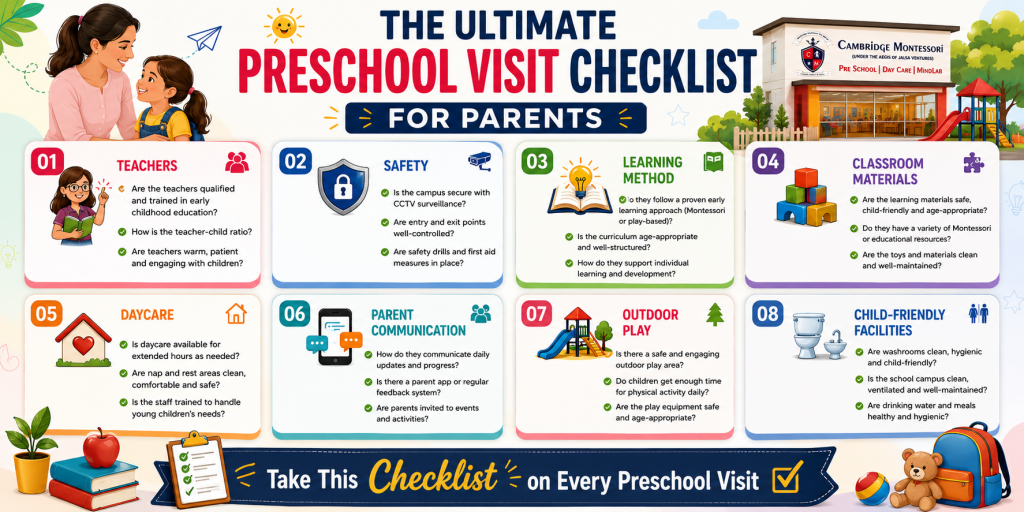
5. A Checklist for Your School Visit
Take this with you:
Does the classroom feel calm, or chaotic?
Are children absorbed in activities, or drifting?
Do teachers interact warmly with individual children?
Are materials on open, child-accessible shelves?
Is the outdoor play space safe and adequate?
Does the school send daily updates, not just termly reports?
Are the washrooms child-sized and clean?
What’s the plan if your child struggles to settle in the first weeks?
That last question is quietly revealing. A good school has a warm, clear settling-in process rather than a shrug and “all children cry at first.”
6. Ask Other Thoraipakkam Parents
In an area full of gated communities and active apartment WhatsApp groups, other parents are your most honest source. They know which preschools genuinely deliver and which simply photograph well. Ask them one blunt question: “Would you send another child there?” The answer cuts straight through the polish.
Cambridge Montessori Preschool in Thoraipakkam
We’re glad to bring Cambridge Montessori Preschool to Thoraipakkam, at Chandrasekaran Avenue, offering an authentic, research-backed Montessori environment right on the OMR corridor.
Our center offers a genuineMontessori prepared environmentwith trained guides, real self-correcting materials, and mixed-age learning, not a preschool that merely borrows the name. Full-day care is built with the same care as the morning, so quality holds through the afternoon. Small class sizes let teachers truly know every child, and daily parent communication means a parent in a TIDEL Park or SIPCOT office at 2pm still knows how their child’s morning went.
Choosing a preschool or daycare in Thoraipakkam doesn’t have to be overwhelming. Set the brochures aside, visit in person, watch the teachers closely, ask the safety questions directly, and trust what you see in the children’s faces. A calm, happy child absorbed in purposeful work tells you more than any marketing pamphlet can.
Your child’s early years are the foundation, not a rehearsal. Choose accordingly.
FAQ (Frequently Asked Question)
Q1: What is the best age to start preschool in Thoraipakkam, Chennai? Ans: Most children are ready for a structured preschool programme between 2.5 and 3 years, which gives them time to settle and build independence before primary school.
Q2: How do I find a good daycare near me in Thoraipakkam for working parents? Ans: Prioritise teacher-to-child ratio, afternoon programme quality, meal standards, daily communication, and a clear emergency protocol. Visit in the afternoon, not just the morning.
Q3: Is a Montessori preschool a good choice in Thoraipakkam? Ans: For most children, yes, and research consistently shows strong outcomes. The best test is to visit and watch how your child responds to the environment.
Q4: How far in advance should I apply for a preschool in Thoraipakkam? Ans: Good preschools here fill quickly given the density of working families along OMR. Applying 3–6 months ahead of your preferred intake, especially the summer season, is sensible.
Q5: What should I look for during a preschool visit in Thoraipakkam? Ans: During your visit, observe how teachers interact with children, whether classrooms are clean and child-friendly, and if learning activities keep children engaged. Also, ask about safety measures, teacher qualifications, class size, outdoor play, and how the school communicates with parents.
Q6: What is the difference between a preschool and a daycare? Ans: A preschool focuses on early learning, social development, and school readiness through structured activities. A daycare provides extended care for children while parents are at work, including meals, rest time, supervised play, and daily routines. Many schools in Thoraipakkam offer both services under one roof.
Q7: How important is the teacher-to-child ratio in a preschool? Ans: The teacher-to-child ratio plays a key role in your child’s learning and safety. Smaller class sizes allow teachers to provide individual attention, support children’s emotional needs, and create a more engaging learning environment.
Q8: How can I tell if a preschool is safe for my child? Ans: A safe preschool should have secure entry and exit procedures, CCTV surveillance, trained staff, child-friendly classrooms, regular hygiene practices, first-aid facilities, and a clear emergency response plan. Don’t hesitate to ask the school about these during your visit.
Q9: Why is location important when choosing a preschool in Thoraipakkam? Ans: Choosing a preschool close to your home or workplace helps reduce travel time and makes daily pick-up and drop-off easier. For families living or working along OMR, a nearby preschool can make the daily routine less stressful for both parents and children.
Q10: How do I know if my child is ready for preschool? Ans: Every child develops at their own pace, but signs of preschool readiness include showing curiosity, enjoying interaction with other children, following simple instructions, and being comfortable spending short periods away from parents. A good preschool will also help children adjust gradually through a supportive settling-in process.
Kuldeep Vaishnaw is a certified Montessori educator with 7 years of experience in early childhood education. As Senior Academic at Cambridge Montessori Preschool, Kuldeep Vaishnaw specializes in child-centered learning and holistic development and regularly shares parenting tips and educational insights on this blog.