How Montessori Builds Independence in Young Children
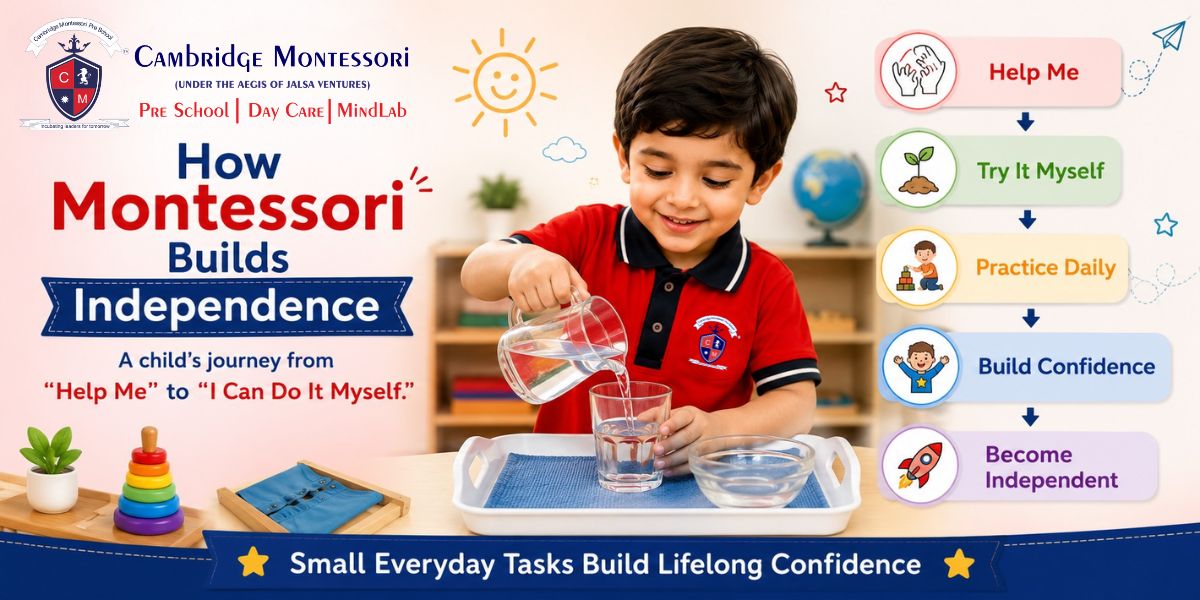
How Montessori Builds Independence : Ask a Montessori teacher to sum up the whole method in one phrase, and many will reach for the same idea Maria Montessori herself used: help me to do it myself.
That single sentence is the engine behind everything in a Montessori classroom. Independence isn’t a happy side effect — it’s the central goal. So how exactly does a good Montessori environment turn a clingy, “do-it-for-me” three-year-old into a capable, self-assured five-year-old? Let’s break it down.
(This article is part of our complete guide: Montessori Education: Everything Parents Need to Know.)
Why Independence Matters So Much
It’s tempting to think of independence as just a convenience — a child who can put on their own shoes is easier to manage. But it runs far deeper than that.
When a child does something genuinely difficult for themselves and succeeds, they absorb a powerful, lasting message: “I am capable.” That belief becomes the foundation for confidence, resilience, and a willingness to try hard things later in life. A child who is always rescued never gets to build it.
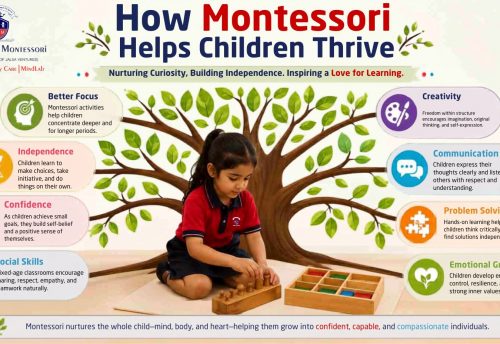
This is also closely tied to the Montessori benefits research keeps finding. The skills behind independence—focus, self-control, planning — are exactly the executive function abilities that the 2025 national randomized trial of Montessori preschool found were significantly stronger in Montessori children.
The Prepared Environment Does the Heavy Lifting
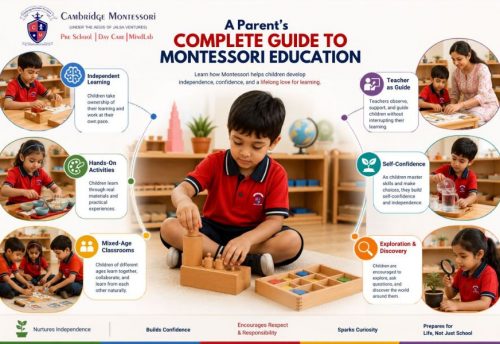
The first secret is the room itself. A Montessori classroom is, in the words of the American Montessori Society, a carefully prepared environment—and almost every feature is designed to let children act without an adult.
Think about it from a child’s height:
- Low, open shelves mean a child can choose, fetch, and return their own materials. No asking permission, no waiting for a teacher.
- Child-sized furniture and tools — real little jugs, brooms, aprons, and buttons — mean tasks are genuinely doable by small hands.
- Order and consistency mean everything has a place. A child always knows where things live, so they can manage themselves.
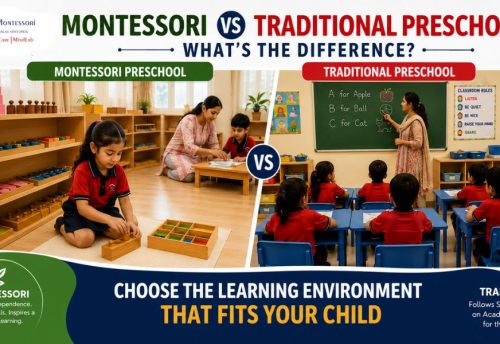
In a traditional setup where everything is adult-height and adult-controlled, children have to rely on grown-ups. Montessori quietly removes that dependence by design.
“Practical Life”: The Heart of Independence
If you visit a Montessori classroom and see a four-year-old carefully spooning beans between bowls, polishing a shoe, or buttoning a frame, you’re watching the most important work in the room: practical life activities.
The American Montessori Society describes how young children learn to care for themselves and their environment through exactly these activities — washing hands, pouring, dusting, sweeping. They look humble, even unremarkable. But they’re doing enormous work:
- building the fine motor control needed for writing,
- developing concentration and sequencing,
- and — crucially — teaching the child that they can take care of themselves.
The child pouring water isn’t just pouring water. They’re rehearsing independence in a safe, repeatable way.
Freedom Within Limits: Learning to Choose
Independence isn’t only about doing — it’s about deciding. In a Montessori classroom, children choose what to work on and for how long, within clear boundaries.
This freedom of choice is itself a skill being practised. Every time a child decides “I’ll work with the number rods now,” they’re exercising judgment, ownership, and self-direction. Over hundreds of small choices, they learn to manage their own time and attention — a skill many adults still struggle with.
The “within limits” part matters too. Freedom isn’t a free-for-all. The boundaries (use materials respectfully, return them for others, don’t disturb a friend’s work) give children a secure framework inside which their independence can grow safely.
Self-Correcting Materials: Mistakes Without a Marker
Here’s a subtle but brilliant detail. Many Montessori materials are self-correcting — they’re designed so the child can spot and fix their own error without a teacher saying “wrong.”
If a child builds the famous pink tower out of order, the result simply looks and feels off, and they notice it themselves. No red pen, no adult judgment. The child becomes their own teacher.
This does something profound for independence: it shifts the source of feedback from “what the grown-up thinks” to “what I can figure out.” Children stop performing for approval and start learning for understanding.
The Teacher Who Knows When to Step Back
Perhaps the hardest part — and it’s harder for the adults than the children. A Montessori guide is trained to observe and wait rather than jump in. When a child struggles to fit a puzzle piece, the trained instinct is to pause, not rescue.
That productive struggle is where independence is forged. Every time we do something for a child that they could do for themselves — with effort — we quietly tell them they aren’t capable. Cambridge Montessori teachers are trained to resist that urge and let the child reach the satisfaction of “I did it” on their own.
Bringing It Home
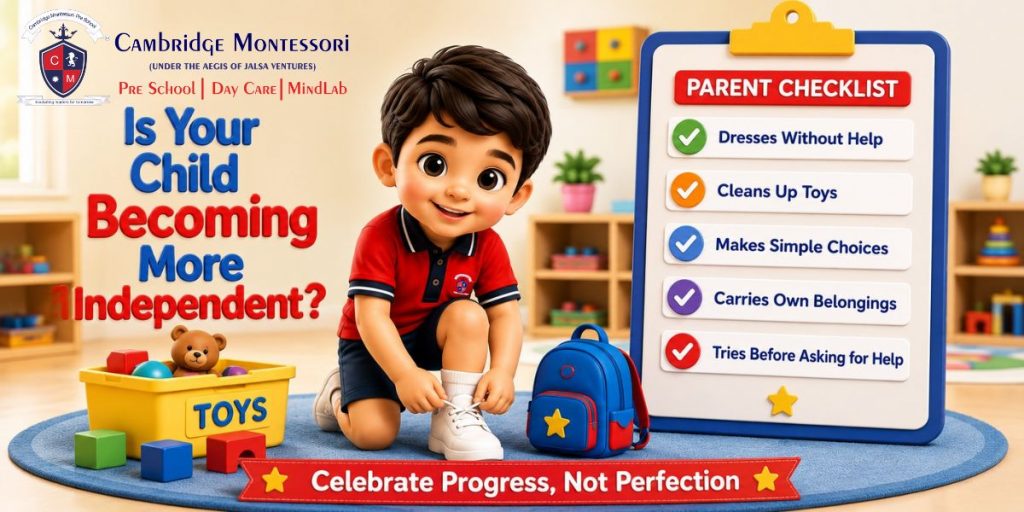
The beautiful thing is that none of this needs a classroom to begin. You can build independence at home with the same principles:
- Put a low hook for their coat and a low shelf for their cup so they can manage themselves.
- Let them do real tasks — washing vegetables, watering plants, setting the table — even if it’s slower and messier.
- Resist the urge to jump in. Count to ten before helping.
- Offer choices within limits: “the red shirt or the blue one?” rather than an open-ended free-for-all.
It takes patience. It is almost always slower in the moment. But you’re not really teaching them to pour water—you’re teaching them that they’re capable.
See It in Action
Independence is one of those things that’s far more convincing to watch than to read about. There’s a particular quiet pride on a child’s face when they finish something hard by themselves.
Book a visit to a Cambridge Montessori Preschool centre near you and watch how a genuinely prepared environment turns “help me” into “I can do it myself.”
Frequently Asked Questions (FAQs)
Q1. How does Montessori help children become more independent?
Ans. Montessori helps children become independent by providing a prepared environment where they can choose activities, complete tasks on their own, and solve problems independently. Practical life activities and child-sized materials encourage children to develop confidence and self-reliance from an early age.
Q2. At what age do children start developing independence in Montessori?
Ans. Children begin developing independence as early as 18 months to 3 years in Montessori programs. Through simple daily tasks like dressing, pouring water, cleaning up, and choosing activities, they gradually build confidence and responsibility.
Q3. What are practical life activities in Montessori?
Ans. Practical life activities are everyday tasks that teach children how to care for themselves and their environment. Examples include pouring water, buttoning clothes, sweeping, washing hands, arranging materials, and preparing simple snacks. These activities develop fine motor skills, concentration, and independence.
Q4. Why are Montessori classrooms designed with child-sized furniture?
Ans. Child-sized furniture, shelves, and learning materials allow children to access and use everything independently without constantly relying on adults. This encourages confidence, responsibility, and self-directed learning.
Q5. How do Montessori teachers encourage independence?
Ans. Montessori teachers act as guides rather than instructors. Instead of immediately helping children, they observe, encourage problem-solving, and provide support only when needed. This allows children to experience the satisfaction of completing tasks independently.
Q6. How do Montessori materials help children learn independently?
Many Montessori materials are self-correcting, allowing children to recognize and fix their own mistakes without adult intervention. This builds confidence, critical thinking, and a growth mindset while encouraging independent learning.
Q7. Can parents encourage Montessori-style independence at home?
Ans. Yes. Parents can support independence by providing child-accessible spaces, allowing children to perform age-appropriate household tasks, offering simple choices, and encouraging them to solve problems before stepping in to help.
Q8. Does Montessori make children more confident?
Ans. Yes. As children successfully complete tasks independently, they develop self-confidence, resilience, and a belief in their own abilities. These experiences help build emotional security and prepare them for future academic and social challenges.
Q9. Is independence in Montessori the same as giving children complete freedom?
Ans. No. Montessori promotes freedom within limits. Children are free to choose activities and work independently while following clear classroom expectations that teach respect, responsibility, and self-discipline.
Q10. Why is independence important during early childhood?
Ans. Independence helps children develop essential life skills such as decision-making, problem-solving, self-confidence, responsibility, and emotional resilience. These skills form the foundation for future learning, leadership, and lifelong success.