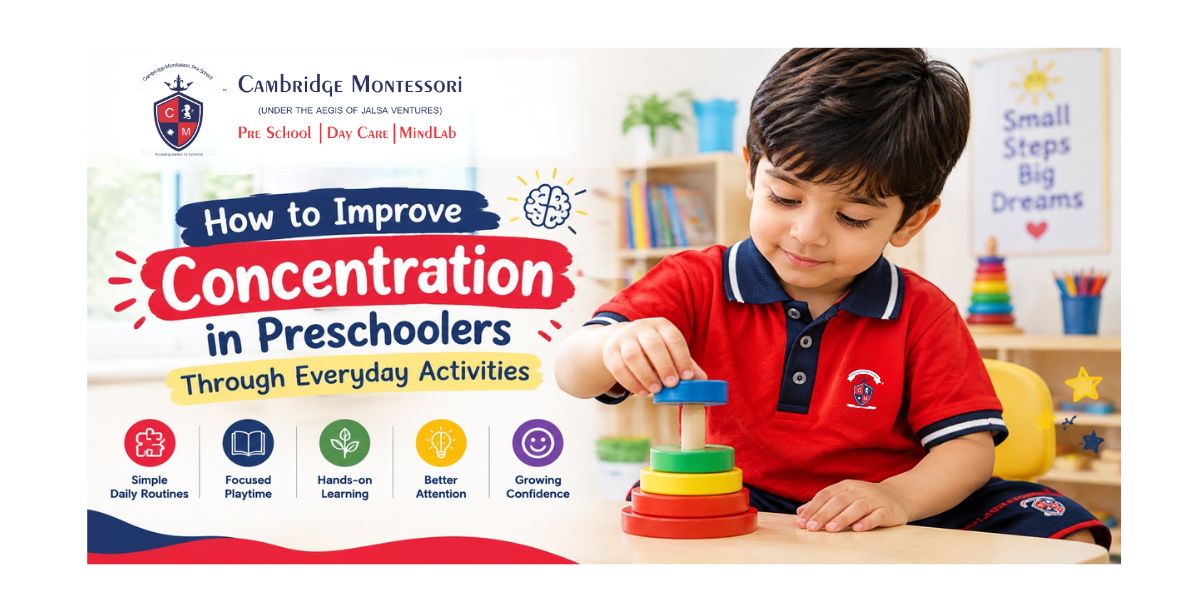
How to Improve Concentration in Preschoolers Through Everyday Activities
Good concentration is important for preschoolers, as it enables learning and helps children stay engaged with different activities. While encouraging concentration, parents should begin with age-appropriate expectations. Attention among preschool children is still developing and can depend on their interest, sleep, hunger, noise, and task difficulty. How to Improve Concentration in Preschoolers Through Everyday Activities is by introducing short, enjoyable, and engaging activities that gradually build attention and focus.
Support Attention Through the Environment
Support children in reducing distractions by reducing background noise and putting away unnecessary toys before any activity. At a time, give one instruction, and ask them to repeat the next step. A predictable routine reduces the effort required to figure out the next action.
Use Games that Practice Executive Function
Games such as matching cards, puzzles, sorting, Simon Says, musical statues, pattern copying and simple board games benefit the working memory, flexible thinking and self-control. Harvard’s Center on the Developing Child provides age-based guides on activities that develop a child’s executive functions [1].The activities can be made more challenging by the parent, by adding more rules, a few more pieces or a longer than usual turn.
Protecting Attention
Attention is influenced by adequate sleep, movement, regular meals, breaks, and a supportive environment. WHO provides excellent guidance on sleep, sedentary behavior, and 24-hour patterns of activity for children under the age of five.
READ MORE : Why Physical Activity Is Important for Preschoolers
Asking for Help
If a child continuously displays a lack of attention across settings and is unable to participate in preschool educational activities, it is best to discuss the concerns with the child’s teachers and a pediatrician. Factors such as a child’s hearing, vision, sleep, language, and emotions can influence attention and may need to be considered.
FAQ’s
Q1: How can I improve concentration in preschoolers?
Ans: Use short, engaging, age-appropriate activities and gradually increase the time your child spends focusing.
Q2: How long can a preschooler concentrate on one activity?
Ans: There is no fixed duration. Attention varies with age, interest, sleep, hunger, and the difficulty of the activity.
Q3: Do worksheets improve concentration in preschoolers?
Ans: Worksheets can be useful, but play-based activities often provide more natural opportunities to develop attention and learning skills.
Q4: Can background television affect a child’s concentration?
Ans: Yes, background television can distract children and reduce their attention during play and other activities.
Q5: Does sleep affect concentration in preschoolers?
Ans: Yes, adequate and consistent sleep can support attention, learning, and overall well-being.
Q6: Can physical activity help improve concentration?
Ans: Yes, regular movement and active play can support healthy development and help children stay engaged.
Q7: Do breaks help preschoolers concentrate better?
Ans: Yes, short breaks can help children manage their attention, especially during activities that require sustained focus.
Q8: Does the learning environment affect concentration?
Ans: Yes, a calm and supportive environment with fewer distractions can make it easier for children to focus.
Q9: When should parents be concerned about a child’s attention?
Ans: If a child consistently struggles with attention across different settings and cannot participate in age-appropriate activities, parents should discuss their concerns with teachers and a pediatrician.
Q10: What factors can affect concentration in preschoolers?
Ans: Sleep, hunger, noise, movement, task difficulty, hearing, vision, language, emotions, and the child’s level of interest can all influence attention.
References
- Harvard Center on the Developing Child Executive Function Activities
- WHO guidelines on physical activity sedentary behaviour and sleep for children under 5
Health note: This article provides general educational information and does not replace advice from a paediatrician or another qualified professional.